

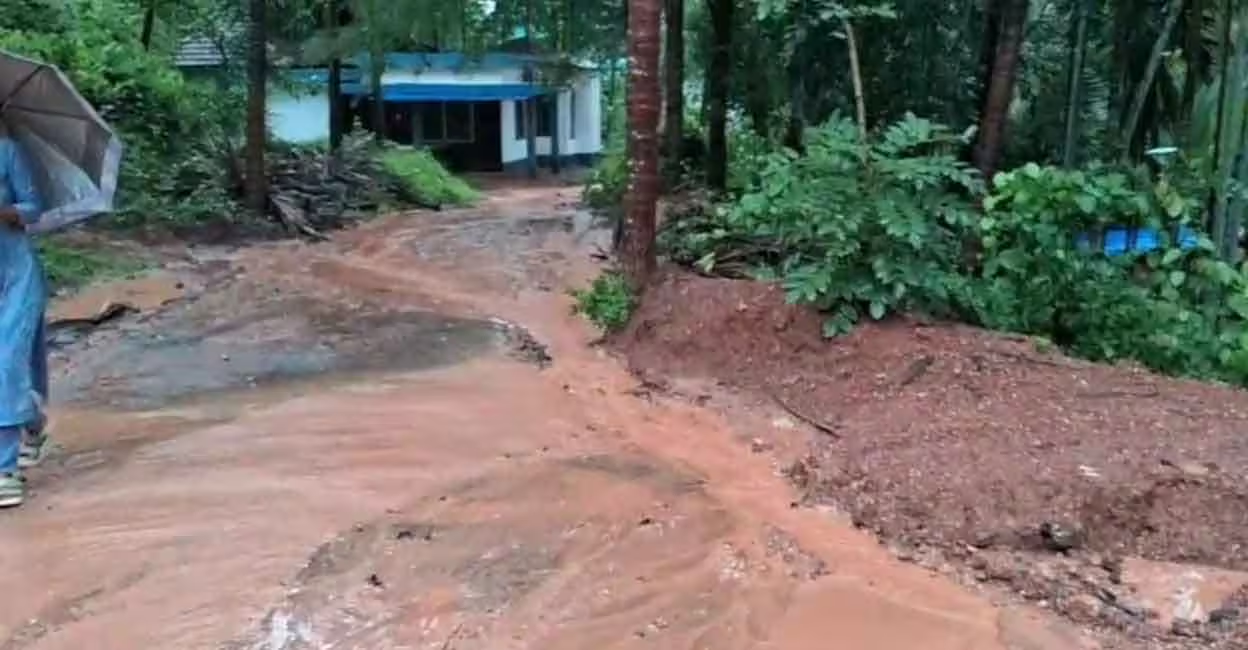
Kasaragod: On Friday morning, residents of Bevinja and Kundadukkam in Chengala panchayat blocked NH 66, after two days of incessant rain brought debris from the elevated highway to their doorsteps, and the only road leading out of the village had turned into a river of red slush.
The blockade lasted only a short while. “We did not want schoolchildren travelling on the highway to be delayed,” said Chengala panchayat member Jayakumari K. But children from her own Kundadukkam ward had missed school because they could not even step out of their house. “The auto I hired to come for the protest also got stuck in the muck,” she said. Jayakumari had to walk to the protest site.
“My children are in Class VI and anganwadi. They did not go to school today,” said Babu, a construction worker from Kundadukkam. “They cannot walk through the mud, and vehicles cannot reach our house.”
Around him, the signs of another monsoon disaster were everywhere. Courtyards paved with interlocking tiles had disappeared beneath knee-deep mud. Wells had turned brown. Paddy fields were buried under silt. A narrow village road was almost indistinguishable beneath the debris washed down from the National Highway construction site.
Residents said this is a man-made disaster, and authorities have no intention of fixing it. “This is the fourth monsoon since the highway work began, and the fourth year we are suffering,” said Arun C S, who works at a printing press.
The mud came from the hill.
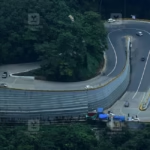
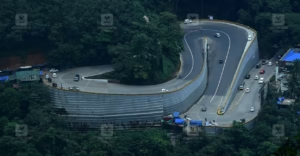
The trouble begins at Cherkala, where the Hyderabad-based Megha Engineering and Infrastructure Limited (MEIL) is constructing an elevated stretch of the six-lane National Highway.
According to residents, enormous quantities of earth excavated for pillars and embankments have been left exposed without adequate safeguards.
“The earth dug out for the pillar foundations has now reached Kundadukkam,” said Jayakumari. “The slush has run through more than 40 houses, farmland and wells.”
The runoff gathered speed during heavy rain on the nights of June 3 and June 4.
At the foot of the elevated highway, residents say a huge pit near one of the pillars collects runoff water. Once the rain intensified, mud and debris flowed downhill. “The red slush flows through my courtyard, past the library and into the paddy fields,” said Babu. “We used to cultivate paddy. For the last four years, because debris keeps flowing down, farming has become impossible.”
The debris has also filled natural streams that once carried rainwater safely through the valley.
“There used to be drainage channels along the old highway,” said Arun. “They demolished them. Now the water simply finds its own route.”
That route now runs through people’s homes. “We are not able to step out,” said Arun.
Jayakumari said she had written to the District Collector several times before the monsoon that this would happen. “But there was no action. I wrote the letter as a panchayat member because I have seen this happening for the past four years since Megha started the construction work. They are a mess,” she said.
A house under slush and debris washed down from NH 66 construction site, 1 km away, at Kundadukkam in Chengala panchayat in Kasaragod. Photo: Special arrangement
Residents fear they are slowly being cut off from the outside world.
From the highway, a narrow road leads through farmland to a cluster of homes.
About 40 families live in Kundadukkam, and another 45 families live in nearby Pulkundam. But the elevated highway is being built without a service road from Cherkala to Chattanchal — a six-km stretch. “In the DPR, these areas are shown as some forest and unpopulated and do not require a service road,” said Arun.
Without a service road, the hamlet with 100-odd families and a lower primary school will be cut off. “We cannot use our roads. We will have to walk 3km to reach Cherkala town,” said Jayakumari.
There are homes with elderly residents and people requiring regular medical attention. “My mother is 80 years old,” said Babu. “She cannot walk.” Residents point to elderly people such as 100-year-old Koran of Pulkundu and 90-year-old Madhavi as examples of those who could become trapped. “There are families with endosulfan victims here too,” Jayakumari said. “What happens if someone needs to be rushed to the hospital?”
Adding to residents’ concerns is what they describe as structural damage near one of the elevated highway pillars.
“There was a crack on the second pillar of the elevated highway,” alleged Jayakumari. Residents raised the issue with the company and demanded that work stop until the matter was examined. “They came at night and plastered the crack,” she alleged.
Residents are equally worried about erosion around the pillar.
“The soil around it has been washed away,” said Babu, who works in the construction sector. “I don’t think the pillar is safe.”
According to her, MEIL officials do not address the fears of the people, and the government does not take up their cause with the NHAI. “Whenever we demand something, they keep saying it is not in the DPR,” she said.
On Friday afternoon, workers had partially cleared portions of the road. But residents know that the rains have only started. “The collectorate officials asked two families to move to the school for the time being. We did that last year. This year, we are not doing it. This is a man-made disaster. They have to resolve it,” said Arun.
Jayakumari said the collector has called for a meeting on Saturday. She is not hopeful of a solution. But she would be attending the meeting. “To be frank,” Babu said, “we are stranded in our own village.”