


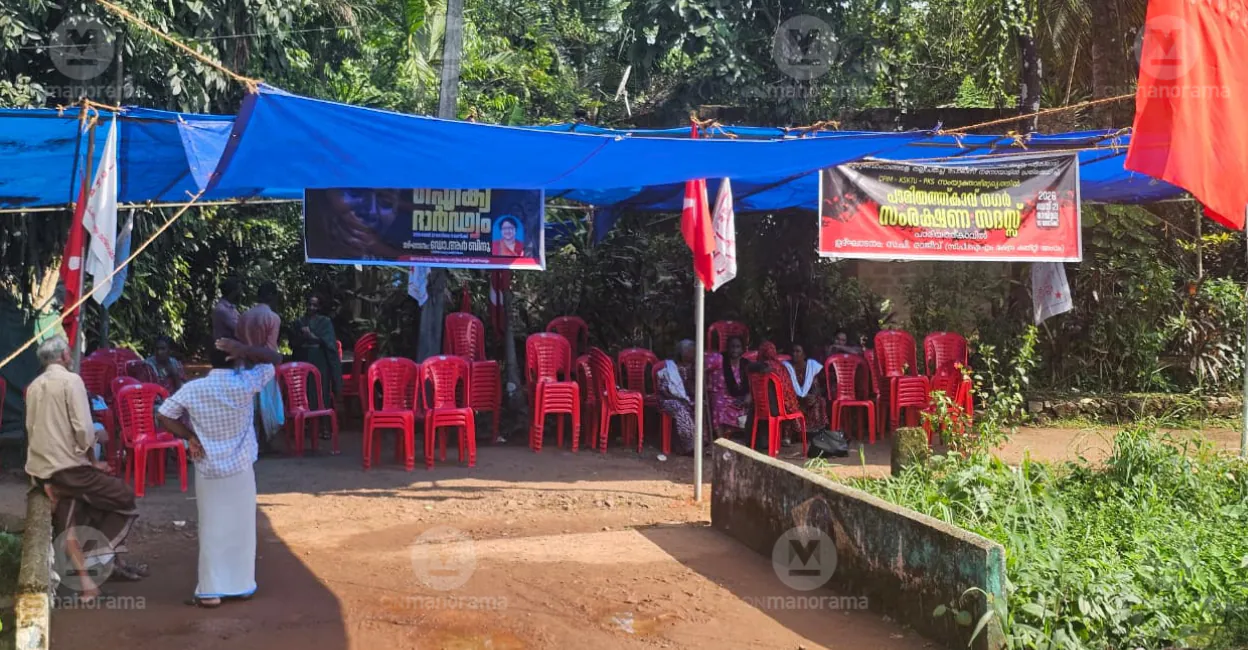
Kochi: When CPM state secretary MV Govindan arrived at the embattled Dalit settlement of Pariyathukavu at Malayidom Thuruthu in Ernakulam’s Kizhakambalam on May 25, he was doing more than expressing solidarity with seven families facing eviction.
He was helping shape what the Left hoped would become the first major political crisis of the newly sworn-in VD Satheesan government.
Just two days after the UDF assumed office on May 18, the 15th attempt to execute a Supreme Court-backed eviction order in a six-decade old land dispute had descended into chaos. The police deployed water cannons, dismantled protest shelters and confronted residents who threatened suicide rather than abandon the land where their families had lived for generations.
Standing amid the turmoil, Govindan accused the government of engineering a ‘mini-Muthanga’, invoking memories of the 2003 police firing on Adivasi protesters at Muthanga in Wayanad, which was a land rights struggle that remains one of the most politically sensitive chapters in Kerala’s recent history.
For a Left Front attempting to regroup after its electoral drubbing, the issue seemed tailor-made for political mobilisation: a contentious eviction involving Dalit families in Ernakulam, where the UDF had swept all 14 Assembly seats. Here was a ready-made narrative: a newly elected government using state power against poor Dalit families.
Yet, for all the war cries and clarion calls for confrontation, the narrative quickly lost steam. Within three weeks, the protest tents had come down, the eviction deadline had been suspended, and dialogue had succeeded where years of confrontation had failed. A legally binding settlement has been signed at the Ernakulam Collectorate. Most significantly, the families at the centre of the dispute have agreed to relocate after securing rehabilitation benefits that allow them to remain in the same locality.
Rather than becoming the UDF’s first political embarrassment, Malayidom Thuruthu has emerged as an example of how the government neutralised a potentially explosive issue through negotiation and administrative intervention.
A crisis six decades in the making
The dispute traces its roots back nearly 60 years to a title claim filed by the landlord Kannoth Shankaran Nair against Kalu Kurumban, a bonded Dalit labourer whose descendants eventually established homes on the disputed property.
Over the decades, the legal battle travelled through multiple courts before culminating in a Supreme Court verdict favouring the landowners. Yet despite repeated attempts during the previous LDF government, the eviction could never be implemented.
By the time the UDF came to power, fourteen previous attempts had failed. The fifteenth attempt exploded almost immediately into a law-and-order crisis.
Visuals of police action against residents generated outrage. The Left quickly moved to occupy the political space. Govindan’s visit was followed by sustained attacks from CPM leaders who portrayed the issue as a test of the government’s commitment to social justice.
The strategy was clear: transform a local land dispute into a statewide political symbol enabling the cadre to regroup, shedding the effect of the humiliating poll defeat.
The confrontation appeared to intensify when Chief Minister VD Satheesan prematurely informed the state assembly that efforts were underway to secure a rehabilitation package and that the affected families agreed to move out of their homes. The CPM leadership in Ernakulam immediately seized upon the statement.
District Secretary S Satish and leaders associated with the agitation publicly accused the Chief Minister of misleading the assembly, pointing out that no formal agreement had yet been reached. Even the affected families too came out against the CM.
At that stage, the government’s credibility appeared vulnerable. Had negotiations failed, the opposition would have possessed a powerful argument that the Chief Minister had betrayed the families.
Instead, the government used a temporary extension obtained from the High Court to buy time for intensive negotiations. That decision changed the course of the dispute.
Shifting the battle to the negotiating table
Rather than pursuing immediate enforcement, the administration brought together residents, landowners and political representatives for multiple rounds of talks. The eventual formula addressed the concerns of all sides.
The seven families secured five cents of land each, a three-metre-wide panchayat road and new 1,000-square-foot houses to be built behind their present residences. They were also permitted to retain reusable materials from their existing homes.
For the landowners, the agreement finally unlocked property rights that had remained trapped in litigation and conflict for decades. Most importantly, the settlement allowed the families to remain rooted in the same area instead of being relocated elsewhere.
The outcome effectively neutralised the central political argument advanced by the opposition. What had been projected as a confrontation between state power and vulnerable residents was transformed into a rehabilitation package accepted by the very families at the heart of the agitation.
Political gains for the UDF
The settlement delivered an early administrative success for Satheesan. For a government barely weeks old, a violent eviction in his home turf Ernakulam could have quickly evolved into a defining controversy. Instead, the administration emerged with a consensus-based solution to one of the district’s most complicated disputes.
The episode also enhanced the profile of Higher Education Minister Roji M John, who played a key role in coordinating the negotiations. Initially dismissed by critics as too inexperienced to handle a six-decade-old legal and social conflict, Roji remained actively involved through multiple rounds of mediation. When Roji said “We solved the six-decade dispute in just five sittings”, it was a big boost for his career too.
KPCC vice-president VP Sajeendran, fresh from reclaiming Kunnathunad from the Left, also invested considerable political capital in the talks, positioning himself as a bridge between residents, officials and landowners. “If the LDF sincerely wanted the families to have their lands, they would have done so during the 14 previous eviction attempts,” he said.
A big setback for the Left
For the CPM, the settlement removed what had appeared to be a promising political opening. Leaders who had rallied around the agitation suddenly found themselves without an issue to mobilise around once the affected families accepted the agreement.
For P Rajeeve, the CPM central committee member and former powerhouse minister from Kalamassery, the UDF’s swift resolution is a deep embarrassment. Rajeeve had long positioned himself as Ernakulam’s ultimate ideological intellectual. Yet, under his regional watch during the previous LDF tenure, the state machinery allowed the eviction standoff to fail 14 separate times, letting local anxiety boil over into a violent time bomb. The new UDF cabinet bypassed years of Left-wing gridlock in under four weeks.
The development was particularly uncomfortable for former Kunnathunad MLA PV Sreenijin, who had emerged as one of the most visible faces of the agitation. His repeated assurances that the eviction would never proceed lost relevance once a mutually acceptable settlement was reached. Sreenijin, who was reeling from the poll defeat, hoped the issue would keep him in the limelight.
More damaging was the public intervention by the heirs of Kannoth Shankaran Nair. After years of avoiding public engagement, they openly criticised the political handling of the issue, accusing local leaders, especially Sreenijin, of prolonging the conflict instead of seeking a practical resolution.
Their remarks shifted attention to an uncomfortable question: why had a dispute that survived fourteen failed eviction attempts not been resolved through dialogue much earlier?
The significance of Malayidom Thuruthu extends beyond the fate of seven families. While it represented the first major opportunity for the opposition to define the new government, Govindan attempted to frame the UDF as hostile to marginalised communities.
Instead, the government transformed the narrative by ensuring that rehabilitation preceded eviction and negotiation replaced confrontation. In the end, the families who stood at the centre of the political battle did not choose permanent resistance. They chose security, housing and stability.
And with that choice, the ‘mini-Muthanga’ that the opposition hoped would haunt the UDF’s opening weeks quietly disappeared.