


[ad_1]
Kozhikode: With heavy rain triggering mudslides and landslips across Wayanad district, fresh cracks that have appeared on the Thamarassery Ghat section of National Highway 766 have raised concerns over the safety of one of Kerala’s busiest hill roads.
The widening of the NH 766 ghat stretch, a crucial link connecting Kozhikode and Wayanad, has been underway for several weeks. Development works are currently being carried out at the sixth and eighth hairpin bends, while authorities have proposed to begin similar works at the seventh hairpin bend after the monsoon.
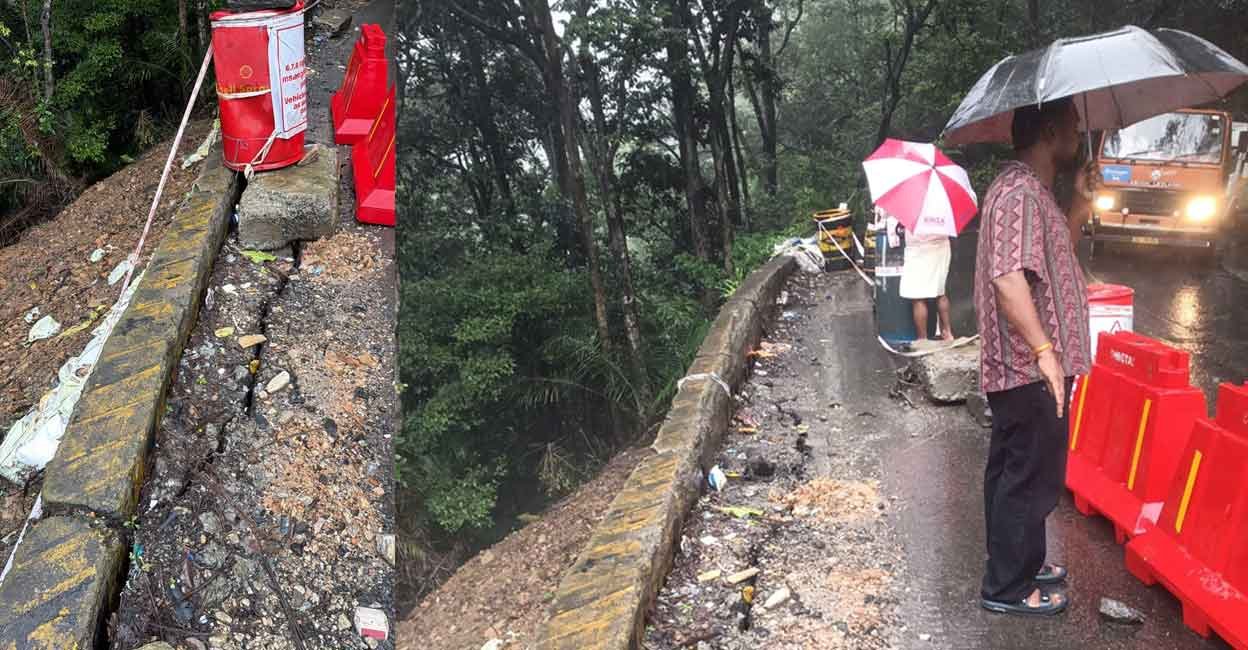
Amid the ongoing construction, a major crack appeared on one side of the road at the eighth hairpin bend on Wednesday morning. The affected stretch is where a retaining wall is being constructed using gabion net technology as part of the road widening project.
The crack extends for nearly five metres along the edge of the carriageway adjacent to the retaining wall. In some places, it is estimated to be as deep as 50 centimetres. The area had earlier undergone tree felling and excavation to facilitate the widening work, making it more vulnerable during the ongoing spell of heavy rain.
Officials fear that continued rainfall could trigger further soil erosion or even landslides in the weakened section. As a precaution, construction activities at the site have been suspended until weather conditions improve. Traffic authorities have also placed barricades and dividers near the cracked portion, warning motorists against driving close to the edge of the road.
To minimise further damage, workers of the contracting firm, assisted by members of the Wayanad Ghat Road Protection Council, covered the affected section with tarpaulin sheets and secured them with sandbags to prevent rainwater from seeping into the cracks. Heavy vehicles are currently allowed to pass through only a single lane at the site, leading to traffic congestion, particularly during peak travel hours.
Apart from the newly developed crack at the eighth hairpin bend, concerns are also mounting over the partially excavated slopes near the sixth hairpin bend. Large rocks have reportedly become exposed following excavation, raising fears that continuous rain could loosen boulders or trigger rockfalls onto the highway.
Residents and members of the Wayanad Ghat Road Protection Council have urged authorities not to undertake fresh excavation during the monsoon.
“Although vehicles are still being allowed through the cracked stretch after temporary safety measures were put in place, the situation remains worrying. At the sixth hairpin bend, large rocks are already visible in the excavated slope. Resuming construction during the rainy season could pose a serious threat to passengers,” said Latheef, a representative of the Wayanad Ghat Road Protection Council.
Officials from the Public Works Department’s National Highways Division in Kozhikode, which is overseeing the project, said adequate precautionary measures have been taken to stabilise the affected area and prevent the cracks from widening.
“We have implemented safety measures to prevent further soil movement and possible mudslips. Construction activities at both the sixth and eighth hairpin bends have been suspended due to heavy rain. Work will resume only after conditions become favourable,” a senior PWD official said.
The official also confirmed that the proposed widening works at the seventh hairpin bend will commence only after the monsoon. According to engineers, the soil in that stretch is particularly fragile and requires careful handling to avoid destabilising the hillside.
The Thamarassery Ghat section, comprising nine hairpin bends, serves as the primary road link between Kozhikode and Wayanad and carries thousands of passenger vehicles, buses and goods carriers every day. Any disruption on the highway has a significant impact on travel and the transportation of essential commodities between the two districts and between Karnataka and Kerala.
With the India Meteorological Department forecasting continued rainfall across northern Kerala, officials said the condition of the vulnerable stretches would be monitored closely, while motorists have been advised to exercise caution and follow traffic restrictions until the road is declared safe.
[ad_2]
Source link