

[ad_1]
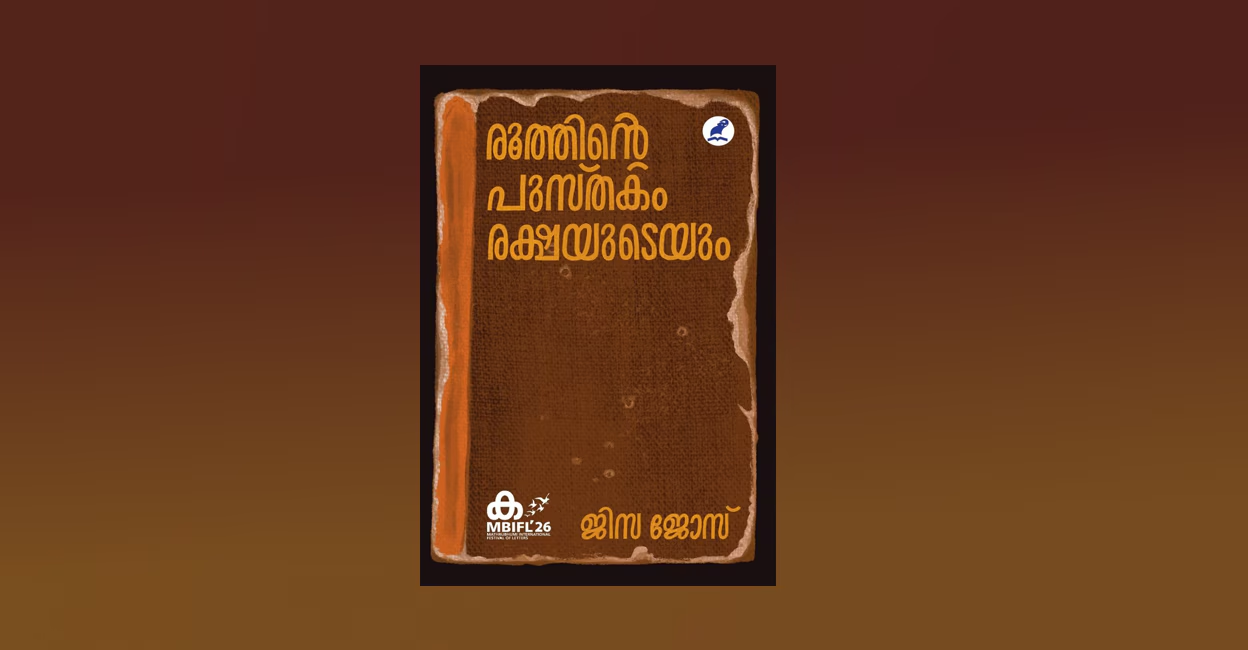
Two women. Two distinct landscapes. Two separate eras. Yet, they are bound by a single, eternal thread: the ceaseless struggle of women to survive. This is the enduring impression left behind by Jisa Jose’s evocative Malayalam novel, Ruthinte Pusthakam Rakshayudeyum. Integrating history, politics, migration, spirituality, and revolution, the book serves as a profound and authentic mirror to the lives of women who have been systematically pushed to the margins.
A tapestry of trauma and memory
The novel begins with a poignant visual: a cloud shaping and dissolving into a teddy bear. This is not merely a whimsical observation, but a deeply embedded psychological trigger for Raksha, a young home nurse. Having grown up with no toys, her only childhood comfort was a tattered, discarded teddy bear pulled from a dirty pond. Decades later, while standing in a hospital corridor as a caregiver, seeing that same shape in the sky reflects her unhealed childhood wounds. It is a quiet reminder that those who carry the scars of an insecure childhood never truly escape their past.
Raksha’s reality is itself a stark critique of our societal structure. Though she holds a master’s degree in Malayalam literature, her Bihari heritage and socioeconomic vulnerabilities have relegated her to the exhausting life of a home nurse. Her intellectual capacity and her menial employment present a glaring contradiction—one that is not a personal failure, but a silent indictment of our systemic divides.
Reshaping identity through stories
Raksha is assigned to care for Ruth, a fiercely independent elderly woman on the brink of death. Ruth does not seek pity or conventional affection; instead, she demands that Raksha write down her life story. Alongside Judith, a writer and distant relative of Ruth, Raksha begins to document these scattered memories. Through this act, the novel evolves from a singular biography into an archive of female experiences, silence, and defiance across generations. When one woman writes another’s story, it ceases to be mere documentation—it becomes a collective memory, a shared act of resistance.
Ruth’s very name is an act of self-preservation. Realising that her baptismal name was lost to the haze of her infancy, she adopted ‘Ruth’ as a fantasy to reconstruct her own identity. Her birth name is withheld from the reader until the very end, serving as a narrative device that highlights the complexity of human self-invention. By adopting the name of a writer she once dreamed of becoming, Ruth reclaims a life that circumstances denied her. While society often pathologises those who reject their assigned identities, for Ruth, it is her ultimate, silent rebellion.
History breathing through ordinary lives
As the narrative flows back to the 1950s, the social, cultural, and political landscape of Kerala comes alive. This is not a historical novel in the conventional sense. Here, history is not a static backdrop; it breathes, speaks, and inflicts wounds on the characters. The hard struggles of peasant families, the waves of migration, religious hegemony, and communist uprisings are active forces shaping human destiny. The novel subtly reminds us that even the smallest insect is affected by the geopolitics, wars, and cultural shifts of its soil. Ruth’s story is a cultural archive of an invisible, unrecorded history of women.
Among the galaxy of women in Ruth’s memories, Deenamma Kunjamma stands out. Bright, imaginative, and eager to learn, she was instead married off to a much older man, her potential swallowed by the endless cycle of domestic labour, livestock rearing, and caregiving. The novel makes a searing sociological observation here: Deenamma’s most brutal oppressors were not the men, but the women of her own household. It is a painful reminder of how patriarchal values are often internalised and reproduced by women themselves, passing down submissiveness as the ultimate virtue.
Rebellions, sewing, and spiritual sanctuary
The book’s canvas is vast. It captures the heartbreak of Chichili, whose body and motherhood bear the scars of the Malabar migration of the 1920s—a movement that reshaped Kozhikode, Wayanad, and Kannur. It also journeys to the volatile landscapes of the Naxalbari movement of 1967 and the subsequent Pulpally rebellion in Kerala. In West Bengal, we see Neelkantha driven to revolution by systemic sexual exploitation. In Manipur, we encounter Chanchal, a victim of ethnic conflict, proving once again that women bear the heaviest toll of male-driven wars.
Remarkably, the novel draws a beautiful symbolic parallel between revolution and the art of tailoring. Both tailoring and revolution dismantle the existing order to piece together something entirely new. Just as a garment is fundamentally altered after being stitched, a society is irrevocably changed after a revolution.
The spiritual dimensions of the book are equally compelling. Raksha’s mother, Amodini, flees Bihar for Kerala in search of love, only to be abandoned and left to raise her daughter through domestic work. In her suffering, she seeks solace in spirituality. This raises a profound question: why are reflective, suffering women throughout history drawn so deeply to spiritual figures like Buddha, Christ, or Krishna? Looking back at the Buddhist Therigatha—the verses of the first ordained nuns—we find that spirituality was often the only domain where women could claim absolute personal and intellectual freedom. In this novel, pain is not glorified, but acknowledged as a transformative force that leads to inner awakening.
By the time the book ends, the reader is left with unresolved questions. What became of Ruth’s unfulfilled love, Somadathan? Where did the paths of Neelkantha and Chanchal lead? Jisa Jose understands that a great novel’s purpose is not to answer all questions, but to keep them alive in the reader’s heart. Ruthinte Pusthakam Rakshayudeyum is an exquisite tribute to those forgotten by official histories, reminding us that while history records the victors, literature preserves the survivors.
[ad_2]
Source link