

Kasaragod: The Gen Z-powered Cockroach Janta Party’s agitation against the NEET paper leak lasted 37 days before Union Education Minister Dharmendra Pradhan resigned on July 25. Less than a week later, Kerala’s final-year MBBS students are questioning the integrity of their own university examination after six of the 15 questions in a gynaecology paper were drawn almost verbatim from a model question paper circulated in advance.
The Thrissur-based Kerala University of Health Sciences (KUHS) conducted the final year’s examination for Obstetrics and Gynaecology (Paper II: Gynaecology and Family Welfare) on July 31. It carried 100 marks spread across 15 questions.
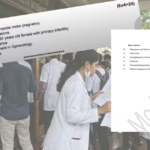
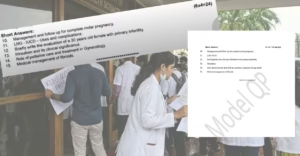
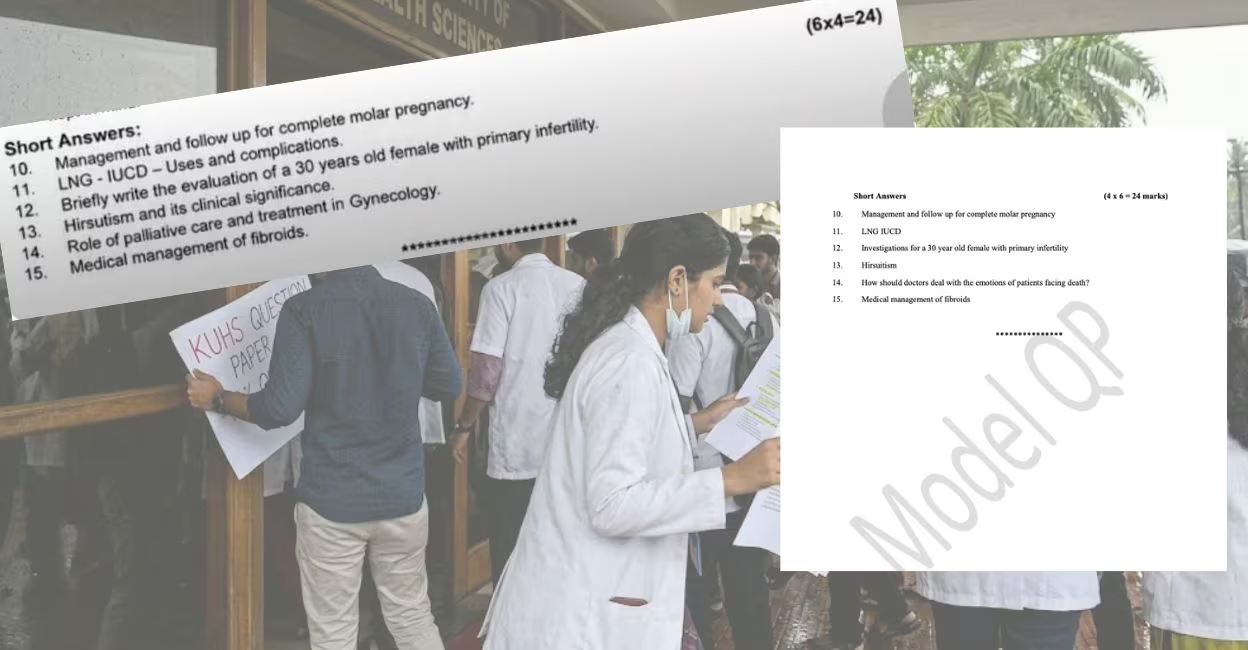
An Onmanorama comparison of the model question paper, available on KUHS’s portal, and the actual examination paper found that six short-answer questions, each carrying four marks- a total of 24 marks- were reproduced almost word-for-word and appeared in the same serial order.
The six questions on the model paper were:
10. Management and follow-up of complete molar pregnancy
11. LNG-IUCD (Levonorgestrel Intrauterine Contraceptive Device)
12. Investigations for a 30-year-old woman with primary infertility
13. Hirsutism
14. Dealing with the emotions of patients facing death
15. Medical management of fibroids
In the university examination, five of the six questions appeared virtually unchanged. The sixth, which in the model paper asked how doctors should deal with the emotions of patients facing death, was rephrased as a question on the role of palliative care and treatment in gynaecology.
That means 40 per cent of the questions in the paper and 24 per cent of the marks came from a model paper already available to students before the examination.
A section of MBBS students told Onmanorama that they created a separate email account and sent a detailed complaint to the university, flagging the repeated questions and seeking an explanation. They say they received neither an acknowledgement nor a response.
When contacted, the university admitted to the lapses. Officials said the model question paper published on the KUHS website was shared with the external faculty member entrusted with setting the examination paper. That might explain how six questions from that model paper found their way into the final examination almost unchanged.
But what is striking is that the same model paper was also provided to the university’s internal scrutiniser, whose job was to vet the question paper before the exam. Despite having the two sets of questions, the scrutiniser also failed to flag the repetitions, said KUHS’s Controller of Examinations Dr Anil Kumar.
“We engaged faculty members from universities outside Kerala to set question papers. The model question paper is shared with them for reference. The scrutiniser is also given the model paper. I think the scrutiniser too missed the repetition,” Dr Kumar said.
Students who contacted Onmanorama said they are divided over whether to seek a re-examination. While some believe the integrity of the examination has been compromised, many are reluctant to undergo the stress and uncertainty of preparing for and writing the paper again after months of study. One student from a government medical college in south Kerala said the extensive repetition of questions provided an undue advantage to candidates who had relied heavily on the model paper rather than broader preparation.
He said two other six-mark essay questions also appeared to resemble questions from the model paper. However, two gynaecologists- one from Kasaragod and another from Idukki- who independently reviewed the papers told Onmanorama that while the examination questions may have been derived from or inspired by the model questions, the underlying clinical scenarios, patient profiles and expected answers were substantially different.
Questions on practical exams
Students told Onmanorama that their anonymous email to the university highlighted concerns about the practical examinations starting August 5. Students questioned the conduct of the Objective Structured Clinical Examination (OSCE), a part of the practical examination, arguing that colleges are now allowed to select their own cases and frame their own questions. According to them, this creates scope for institutions to choose cases that favour their students.
They want KUHS to standardise OSCE cases across colleges, similar to theory examinations, arguing that different colleges may otherwise assess students using varying levels of difficulty.
Dr Anil Kumar dismissed the proposal, arguing that centrally prepared OSCE cases would increase the possibility of leaks and defeat the very purpose of the examination.
According to him, clinical examinations are built around real patients who attend outpatient departments on the day of the examination. “Colleges select a patient and frame four or five questions based on that patient’s condition. Students are assessed on clinical skills, examination techniques and the investigations they would order. This is intended to maximise objectivity,” he said.
Students have also objected to recent changes in the appointment of practical examiners. According to them, practical examinations were earlier conducted by four examiners- two internal and two external. One of the external examiners had to be from outside Kerala, while another had to be from outside the university zone.
KUHS divides the state into three examination zones: the south zone comprising Thiruvananthapuram, Kollam and Alappuzha; the central zone comprising Pathanamthitta, Kottayam, Idukki and Ernakulam; and the north zone comprising the seven districts from Thrissur to Kasaragod.
Students allege that the university has gradually diluted these safeguards. They claim the requirement for an examiner from outside Kerala was removed last year and the requirement for an examiner from outside the zone was dropped this year. “As long as the examiner is from another college, they are now treated as external,” a student said.
University officials defended the changes, saying they were introduced in line with National Medical Commission guidelines.
Students, however, hope the episode will prompt a broader review of medical examinations and practicals in Kerala, at a time when the credibility of high-stakes examinations is under scrutiny nationwide.