

[ad_1]
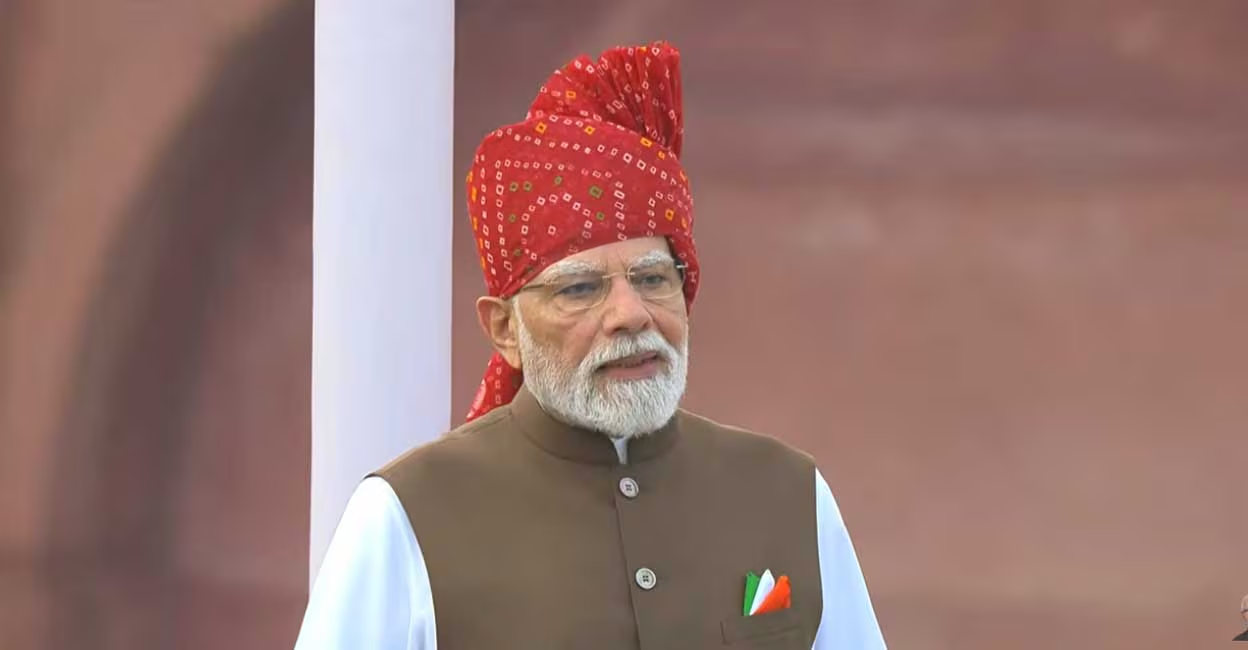
New Delhi: India celebrated its 80th Independence Day on Saturday, with Prime Minister Narendra Modi leading the national celebrations at the Red Fort. For the first time since Independence, Vande Mataram echoed from the ramparts of the historic venue, followed by the National Anthem.
Addressing the nation, Modi called on Indians to “dream big” to achieve the goal of a developed India, or Viksit Bharat, by 2047. He said the country’s progress over the past 12 years had taken India from the “fragile five” to among the world’s major economies.
“Powered by 140 crore Indians, our nation is scaling new heights of progress across different sectors,” Modi said.
Modi inspected the Guard of Honour at the Red Fort before hoisting the national flag and delivering his Independence Day address. Ahead of the ceremony, Modi visited Raj Ghat and paid floral tributes to Mahatma Gandhi, honouring the Father of the Nation on the occasion of Independence Day.
Earlier, the prime minister greeted people on Independence Day and paid tribute to the countless freedom fighters whose courage, sacrifice and unwavering commitment brought an end to colonial rule.
Stressing the need for self-reliance, the prime minister said India could not remain dependent on other countries and urged people to embrace “Vocal for Local” and indigenous products. He highlighted the country’s progress in semiconductor manufacturing and said India had also emerged as a source of critical minerals for several countries.
Modi also highlighted India’s efforts to become self-reliant in nuclear energy. He said the Prototype Fast Breeder Reactor at Kalpakkam in Tamil Nadu had attained criticality this year and noted that Parliament had passed the SHANTI Act. India has set a target of achieving 100 GW of nuclear power capacity by 2047 and establishing five new nuclear reactors.
Focus on defence self-reliance
A major focus of Modi’s address was defence manufacturing, with the prime minister pitching India as a global hub for defence production and next-generation military technology.
“We have to become global supplier by leveraging next generation defence technology,” he said.
Modi called for greater expertise in advanced capabilities such as hypersonic technology, drones and counter-drone systems. He said expanding domestic defence production was critical to strengthening India’s strategic capabilities.
He also said work on the indigenous Sudarshan Chakra air defence system was progressing rapidly. Modi had announced the project on August 15 last year. The system is aimed at strengthening India’s air defence and protecting vital military and civilian installations.
India’s domestic defence production rose to ₹1.78 lakh crore in the financial year 2025-26 from ₹46,000 crore in 2014, according to government data. Defence exports also reached ₹38,424 crore in 2025-26. Modi said India’s defence exports had increased 50 times and that Indian military hardware was being supplied to nearly 100 countries.
The prime minister also announced that a comprehensive network of civil defence personnel would be developed, while underlining the need to strengthen the country’s preparedness against external and internal security threats.
Modi said India’s defence production had increased fourfold over the past 12 years, while electronic manufacturing had grown sevenfold, high-tech railway coach production 21-fold and mobile phone manufacturing 33-fold.
He also highlighted the rapid expansion of railway electrification, saying 70 per cent of the network had been electrified in the past 10 years compared with 30 per cent in the previous 90 years.
The prime minister said India’s self-reliance had helped the country withstand crises, including the Covid-19 pandemic and the recent West Asia crisis. He said there was no shortage of gas, fuel or urea in the country despite concerns raised during the crises.
The celebrations at the Red Fort also mark 150 years of the enduring legacy of Vande Mataram and highlight the contribution of the country’s youth to the vision of Viksit Bharat by 2047. At the conclusion of Modi’s address, 2,500 NCC cadets and My Bharat volunteers are scheduled to sing the National Song, followed by the National Anthem.
President Droupadi Murmu, in her address to the nation on the eve of Independence Day, stressed the need to protect the future of India’s youth. She said the government was undertaking comprehensive reforms to make public examinations more transparent, secure and trustworthy and to curb paper leaks and unfair practices.
Murmu also highlighted India’s economic progress, youth entrepreneurship, women’s empowerment, sports and technological development. She said India was moving towards the goal of becoming a developed nation by 2047, driven by economic resilience, digital infrastructure and empowered youth and women.
She paid tribute to the freedom fighters and remembered Mahatma Gandhi, B R Ambedkar and Sardar Vallabhbhai Patel. She also remembered those who lost their lives or were displaced during Partition.
Congress president Mallikarjun Kharge, meanwhile, said India’s constitutional values, democratic institutions and social harmony had faced “serious challenges” over the past decade.
Kharge said freedom meant more than liberation from British rule and included the constitutional guarantees of equality, dignity, justice and freedom of expression. He called for equal opportunities and justice for youth, farmers, women, Dalits, Adivasis, OBCs, minorities and economically weaker sections.
Across the country, Independence Day celebrations include flag-hoisting ceremonies, cultural programmes and patriotic performances. Patriotic band performances are being held at 343 prominent locations, while nearly 5,000 special guests from different walks of life have been invited to the Red Fort celebrations.
In Delhi, security has been tightened around the Red Fort and other sensitive locations, with more than 25,000 Delhi Police and paramilitary personnel deployed. More than 1,000 CCTV cameras equipped with AI-based video analytics are being used around the Red Fort as part of a multi-layered security arrangement.
[ad_2]
Source link