


[ad_1]
Kochi: For more than eleven months, seven merchant sailors from Russia, the Philippines, Ukraine, and Georgia have been living in a state of “semi-arrest” inside a hotel room in Kochi. Having narrowly escaped with their lives when their cargo ship, MSC Elsa 3, capsized and sank off the coast of Kochi in May last year, the mariners now find themselves trapped in a secondary crisis: a grinding legal stalemate that has cut them off from their careers, wrecked their mental health, and, in one heartbreaking case, left an aging wife to battle advanced cancer alone thousands of miles away.
The crew’s prolonged ordeal has culminated in an urgent writ petition filed before the High Court of Kerala. While public focus initially centred on their legal battle to recover their passports, the specific grounds detailed in their plea highlight an escalating humanitarian crisis that goes beyond a standard maritime dispute.
A main aspect of the crew’s plea is the agonising situation of 69-year-old Ukrainian national Valeriy Hordyeyev, who served as the ship’s Electro-Technical Officer (ETO).
Far away in war-torn Ukraine, Hordyeyev’s 70-year-old wife has been diagnosed with Stage 3 Cervical Cancer. She is entirely alone, with no family members nearby to help with her daily needs or arrange her critical medical treatments. Between February 1 and February 12, 2026, Hordyeyev sent urgent, direct letters to the Mercantile Marine Department (MMD) in Kochi, begging to be released on purely compassionate grounds so he could return to her.
On March 2, 2026, the ship’s manager, Capt. Manish Gupta, followed up with a binding legal and financial corporate guarantee. The company promised it would ensure Hordyeyev cooperated with all future investigations digitally, or even fly him back physically if required. However, as the petition claims, the authorities ignored the requests. For Hordyeyev, every day spent stranded in Kochi is a period of deep psychological torment, watching his wife navigate a terminal illness without his support.
The ETO’s story is a severe window into a shared trauma gripping all seven petitioners. The crew, which includes Captain Ivanov Alexander (61, Russia), Chief Officer Reynold Paredes Mahinay (60, Philippines), Chief Engineer Oleksii Chornyi (50, Ukraine), 2nd Engineer Kakhidze Roman (55, Georgia), Able Seaman Castaneda Ronald Punzalan (44, Philippines), and Motorman Velasco Ryan Ontolan (33, Philippines), have been confined to a hotel in Ernakulam for nearly a year.
The petition, moved through advocate Pranoy K Kottaram, describes the severe mental anguish and psychological toll this open-ended, indefinite detention has taken on the men. As active, highly specialised merchant sailors, being physically barred from going back to sea has inflicted catastrophic damage to their careers and their financial standings back home.
The mariners argue that this forced stay amounts to an unauthorised executive detention. They contend it directly violates their fundamental rights under Article 21 (Right to life and personal liberty) and Article 14 (Right to equality and protection against arbitrary discrimination) of the Constitution of India, protections that are applicable to foreign nationals while on Indian soil.
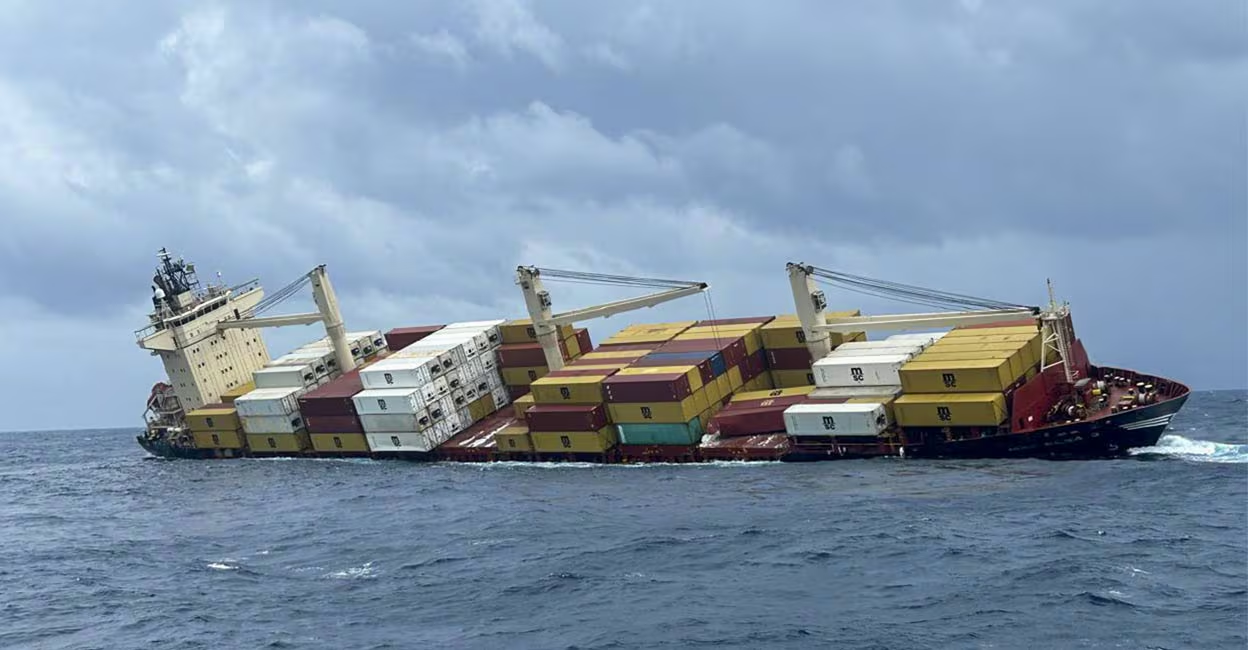
According to the plea, the irony of their current confinement is not lost on the seafarers. On May 24, 2025, just a day after departing Vizhinjam Port for Kochi under harsh weather conditions, the MSC Elsa 3 developed a severe technical tilt – ‘listing’ in nautical parlance – to its right side. When the Director General of Shipping (DG Shipping) issued an order to abandon the ship, 21 crew members were safely evacuated.
However, Captain Alexander, Chief Engineer Chornyi, and 2nd Engineer Roman voluntarily chose to risk their lives. The petition submitted that they refused the initial rescue, staying aboard the tilting ship in a desperate, brave attempt to balance the water tanks and save the vessel. It was only at 7:50 am on May 25, minutes before the ship capsized and sank 14.4 nautical miles off Kochi, that they were rescued from the water by the Indian Coast Guard and Navy.
Once they were safely on land, the bureaucratic machinery tightened. The MMD Kochi issued a restrictive notice barring the remaining crew from leaving Kochi without written permission. Statements were comprehensively recorded over a three-week period ending June 19, 2025, and the crew hasn’t been called for questioning since.
The situation took a frustrating turn on August 8, 2025, when DG Shipping issued a conditional No-Objection Certificate allowing 15 of the crew members to be safely sent home. However, the order split the crew, keeping the remaining seven petitioners behind by terming them “key personnel” and “material witnesses” essential to the investigation. Two other officers who initially had their travel papers withheld were only able to leave after the Kerala High Court stepped in later that December, allowing their passports to be released against financial bonds.
Compounding their isolation, the Coastal Police Station in Fort Kochi registered an FIR following a complaint by a local fisherman regarding environmental concerns over escaping plastic debris from the sunken ship. Though the FIR names the ship’s owners and generic “crew”, none of the seven petitioners have been individually singled out as culprits.
Yet, acting under Section 94 of the Bharatiya Nagarik Suraksha Sanhita (BNSS), 2023, the coastal police physically seized the crew’s original passports. The petitioners argue this continuous withholding is an abuse of power. Citing a Supreme Court precedent,the petition claims that passports are travel credentials, not items of evidence required to prove a maritime accident, and cannot be kept indefinitely by the police.
Furthermore, the petition highlights that India has been a member signatory of the International Maritime Organization (IMO) since 1959. By keeping the mariners stranded, the authorities are operating in direct defiance of the 2006 IMO Guidelines on Fair Treatment of Seafarers. These rules explicitly state that countries must use digital or recorded testimony to avoid holding mariners physically, handle inquiries quickly, and let crew members return home without undue delay.
The final trigger forcing the crew to approach the High Court was a letter issued by DG Shipping on April 2, 2026. The administrative body stated that it would only lift its travel objections after MMD Kochi formally completes its internal Preliminary Investigation report, which is a process with no clear deadline, as said in the petition. Because the matter was caught in paperwork, DG Shipping told the crew they must seek relief from a judicial court.
The seven mariners are asking the High Court to compel DG Shipping to issue an unconditional No-Objection Certificate. They are also seeking the immediate return of their passports and the cancellation of the original 2025 restrictive notice, so that they could fly back home under specified conditions, similar to when other crew members were allowed to repatriate earlier.
[ad_2]
Source link