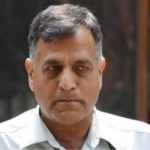


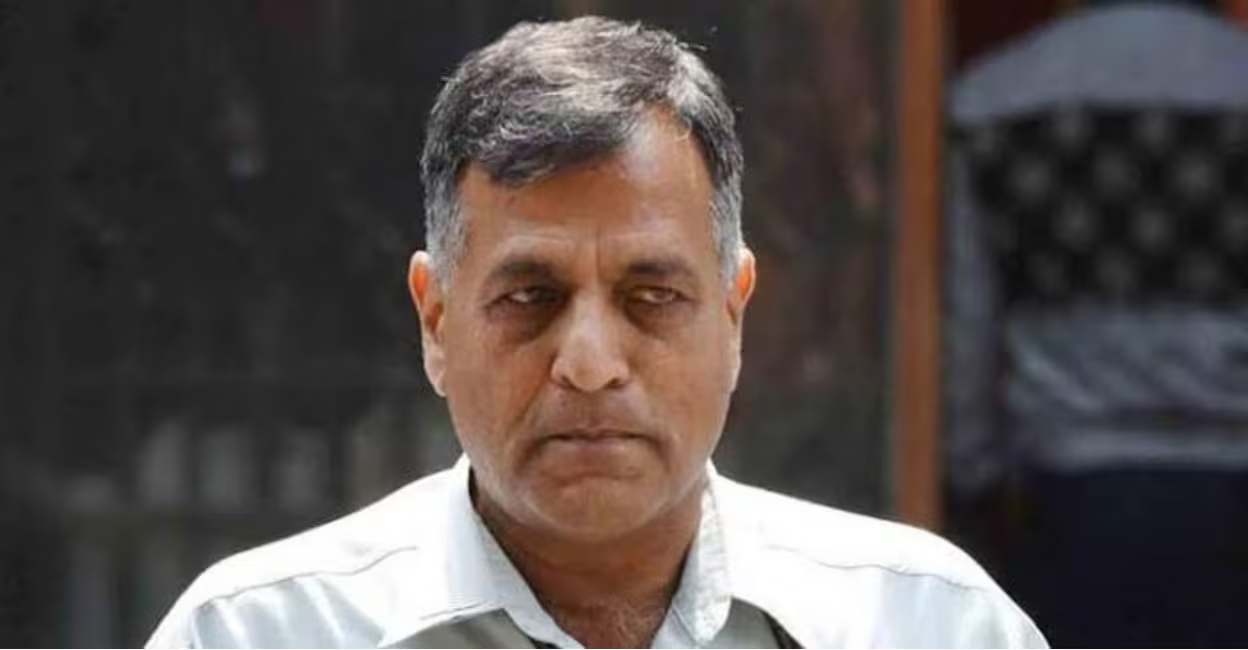
Former Election Commissioner Ashok Lavasa speaks on Form 6, the Special Intensive Revision (SIR), differences within the Election Commission and apprehensions over its decisions.
The changes to Form 6 have sparked controversy. Who has the legal authority to make these changes?
Form 6 is prescribed under the Registration of Electors Rules. So, any amendment to the form would require an amendment to the rules, which can be made only with the government’s approval. My understanding is that the Election Commissioners had opposed the changes to Form 6. Even if they were unanimous in favour of the changes, in my view, the Election Commission has no authority to make such changes without the government’s approval.
Why does a voter have to provide the electoral roll number of their parents, grandparents or other relatives? Does this have anything to do with the right to vote?
Why should I be required to provide the electoral roll number of my parent, grandparent or other relative? Under Article 326 of the Constitution, if I am eligible to vote, no additional conditions can be imposed for inclusion of my name in the electoral roll.
Form 6 includes an affidavit stating that the applicant is a first-time voter and has not been registered elsewhere. What happens to those who were registered earlier but have now been deleted from the electoral roll?
These are two separate issues. One concerns the Form 6 amendment requiring the details of parents and grandparents. The other is the affidavit. How can someone whose name has been deleted from the current electoral roll give an affidavit stating that they have not been registered elsewhere? That is certainly an error.
Two Election Commissioners have said they disagree with some of the orders and decisions of the Chief Election Commissioner. What does the law say about this?
The law is clear. Decisions should, as far as possible, be taken unanimously. If that is not possible, they should be based on the majority view. That is how all decisions are taken.
If the law allows decisions to be taken by majority, why are the current differences within the Election Commission attracting so much attention?
From the information that has come out so far, it may appear at first glance that there are differences of opinion. But to know whether a decision was unanimous or taken by completely disregarding the views of the other Election Commissioners, all the facts need to be made public.
What does the Election Commission need to tell the public about how it dealt with the disagreements within the Commission?
If one or two Election Commissioners have raised objections, the Commission has a responsibility to tell the public how those objections were dealt with. Were they examined? Was the file placed before the Commission again before the final decision was taken? Or was the issue discussed at a Commission meeting? If so, what was discussed and who took part? Without these details, how can we draw any conclusion?
So, are you saying that citing the majority decision as the sole reason does not explain how the dissenting views were dealt with?
We need to know all the facts. We know that objections were raised, but do we know what process was followed to deal with them? That is why the Commission should disclose how those objections were taken into account.
Do you expect the controversy over the Commission’s internal decision-making process to come under the Supreme Court’s scrutiny?
If the Supreme Court wants to examine these matters, it can. But I don’t know what the court will do.
There is an argument that if the decisions related to the SIR are found to be wrong, elections held based on those electoral rolls could also be challenged. Could that ultimately lead to fresh elections?
No. These are two entirely different issues. Whether a decision was taken by majority or not is one matter. Concluding that all elections held based on this SIR should therefore be cancelled is an entirely different matter.
Why do you say the two issues need to be looked at separately?
Even in the case of the current SIR, whether an election should be cancelled has to be examined in the context of the process followed in that particular exercise. The procedures followed in the three phases were different. What was done in Bihar was not necessarily what was done in the second phase, and what was done in the second phase was not necessarily what was done in the third. Each of these processes has to be examined separately. We cannot arrive at a general conclusion that all elections held based on an allegedly flawed SIR should be cancelled, or that they can automatically be cancelled.
Don’t you think there is merit in the argument that all elections held based on the SIR should automatically be cancelled?
I would not draw such a conclusion. I don’t know what position the court will take. But I don’t think there is merit in that argument.
There have also been concerns over Electoral Registration Officers (EROs) facing difficulties in accessing ECI NET. How do you view the issue?
That is an internal issue. We do not yet know whether access is actually being blocked. But there was an instance where an ERO sent eight emails to the Election Commission after facing difficulties in registering 97% of the voters. The question is why the Commission designed a system that creates difficulties for an officer who is legally authorised to carry out the work. The Commission needs to answer that.
Does this reinforce the larger concern you have raised about transparency within the Election Commission?
Yes. Whether it is an objection raised by an Election Commissioner or a difficulty reported by an ERO, the important question is how the Commission dealt with it. Without full details of what was reported, what action was taken and how the issue was resolved, it is difficult for those outside the Commission to draw any conclusion.