


Malappuram: The interim report on the proposed Kerala High-Speed Railway (KHSR) corridor between Thiruvananthapuram (Poojapura) and Kannur (Mundayad), submitted by Metro Man E Sreedharan to Chief Minister V D Satheesan, proposes a fully elevated standard-gauge double-line railway, with the total project cost estimated at ₹60,000 crore.
The details of the report were released by the Ponnani regional office of the Delhi Metro Rail Corporation (DMRC) on Saturday following public debate and protests over various aspects of the proposed project.
According to the report, the 473.2-km corridor would have 23 stations and would be constructed predominantly as an elevated structure. Only a 6.5-km stretch within Thiruvananthapuram city was proposed to run through tunnels.
The line is planned to connect all three major airports in Kerala —Thiruvananthapuram, Kochi and Kozhikode— while Kannur Airport would be linked through a dedicated 10-km access road. The end-to-end travel time between Thiruvananthapuram and Kannur was estimated at three hours and 30 minutes.
The report also outlines future expansion plans, including extensions from Kannur to Kasaragod and branch lines from Kozhikode to Kalpetta, Pattambi to Palakkad, and Thrissur to Palakkad. Junction stations required for these future phases have been incorporated into the initial design.
23 stations would be located at Poojappura, Thiruvananthapuram Airport, Varkala, Kollam, Kottarakkara, Pathanamthitta Junction, Thiruvalla, Kottayam, Vaikom, Tripunithura, Ernakulam (Palarivattom), Aluva, Kochi Airport, Chalakudy, Thrissur Junction, Pattambi Junction, Malappuram, Kozhikode Airport, Kozhikode Junction, Balussery, Nadapuram, Koothuparamba, and Kannur (Mundayad).
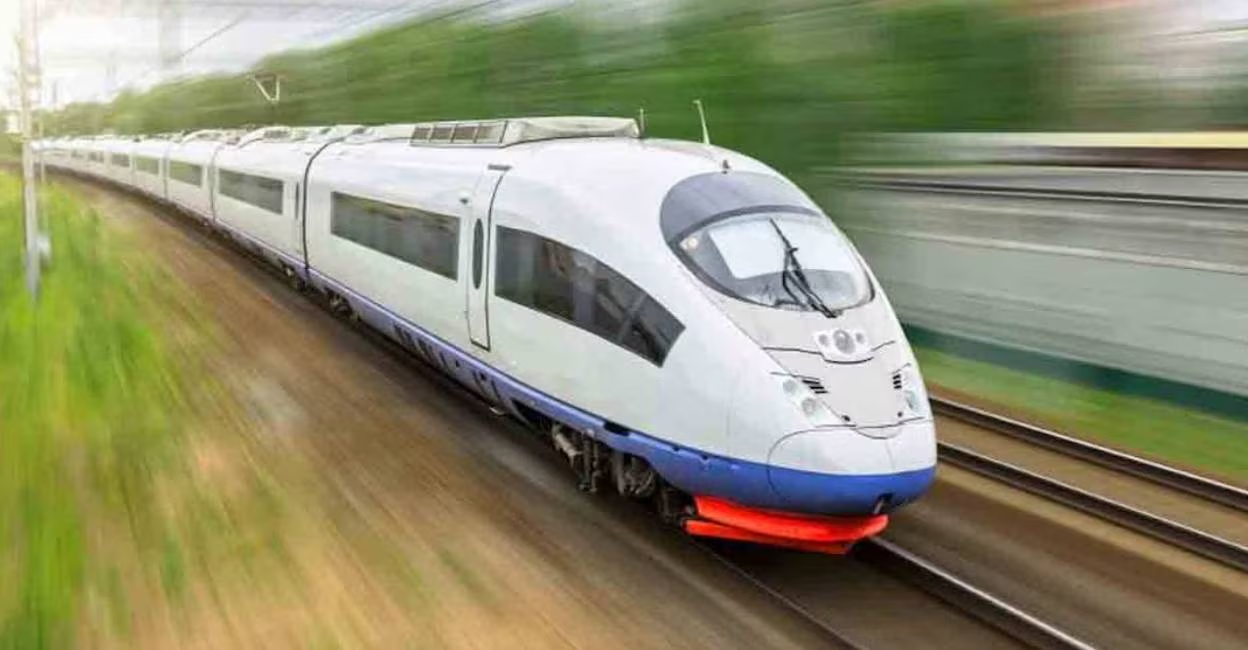
The proposed line will have a maximum design speed of 200 kmph, an operational speed of 180 kmph and an average commercial speed of 140 kmph. Trains will initially consist of 12 coaches with seating for 800 passengers, though platforms will be built to accommodate 16-coach trains in the future.
During peak hours (6 am–11 am and 4 pm–8 pm), services are proposed at 20-minute intervals, while trains will operate every 40 minutes during off-peak hours. The initial carrying capacity is estimated at 54,400 passengers per day. With reduced headways of five minutes during peak periods and 10 minutes during non-peak hours, the system could accommodate up to 2.28 lakh passengers daily. The report states that all travel would be reservation-based, with no standing passengers permitted.
The KHSR has been proposed on standard gauge, with the report arguing that a lower axle load of 15 tonnes, compared to 25 tonnes on broad gauge, would significantly reduce both capital and operational costs. It also notes that most modern high-speed rail systems worldwide operate on standard gauge, facilitating technology upgrades and future innovation.
Land acquisition requirements are projected to be minimal, with only a 20-metre-wide corridor needed for construction. The report suggests that land could be leased back to original owners after completion for cultivation or grazing under specified conditions.
A captive solar power system is proposed to meet the railway’s entire energy requirement, with surplus electricity to be supplied to the Kerala State Electricity Board (KSEB). The project is being presented as a potential “Green Rail Corridor”.
Of the total project cost of ₹60,000 crore, ₹36,000 crore is proposed to be contributed as equity by the Central and State governments in a 51:49 ratio, while the remaining ₹24,000 crore would be raised through crowdfunding. The average construction cost is estimated at ₹127 crore per kilometre.
According to the interim report, the project could be completed within five years of receiving the necessary approvals.