

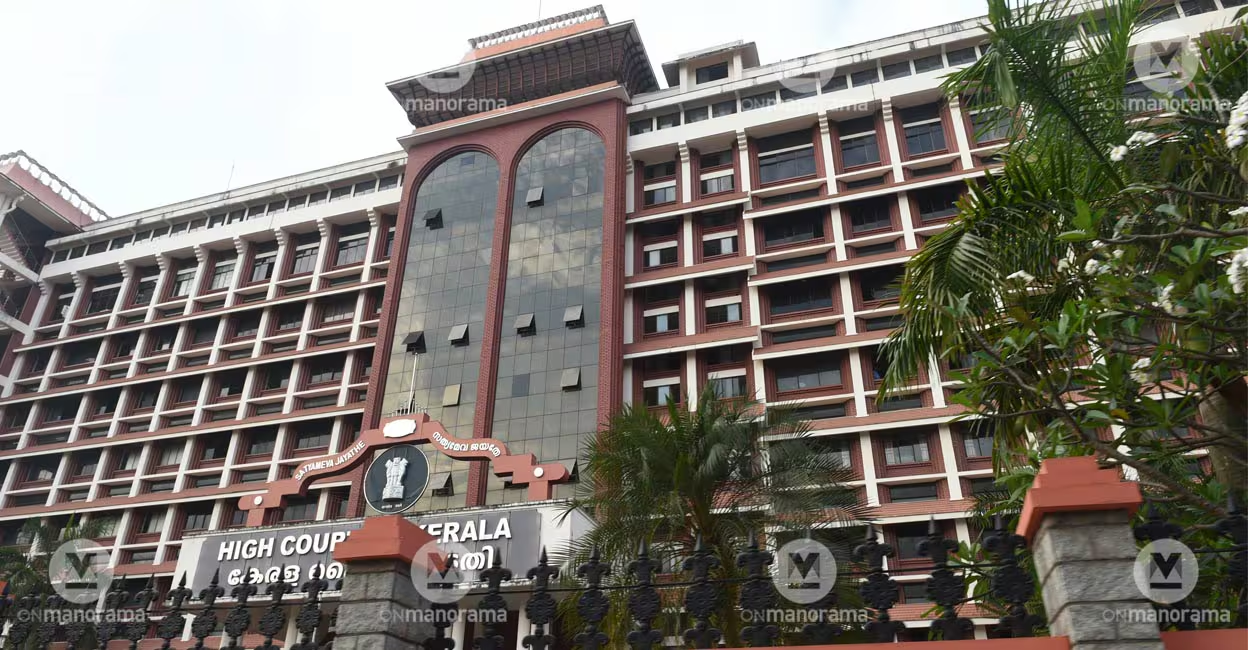
Kochi: Four persons convicted in connection with the 2003 Muthanga land struggle have approached the Kerala High Court challenging their conviction, arguing that the trial court wrongly relied on a prima facie finding of criminal conspiracy to hold them guilty.
The appellants, social activist M Geethanandan, Binu, Ramesan and Anilkumar, were among the 57 people prosecuted in the case arising from the violent clashes between police and Adivasi protesters during an eviction drive at the Muthanga Wildlife Sanctuary in Wayanad.
The confrontation took place after Adivasi protesters under the banner of the Adivasi Gothra Maha Sabha (AGMS) occupied forest land. Violence erupted during the police eviction operation, prompting police to open fire. Eighteen rounds were fired, leading to the immediate deaths of two protester. Police constable KV Vinod was also killed in the incident.
On July 31, 2026, the Principal Sessions Court in Kalpetta convicted the four appellants on charges including unlawful assembly, rioting, wrongful restraint, wrongful confinement, voluntarily causing hurt and grievous hurt to public servants, criminal intimidation, kidnapping, causing hurt with dangerous weapons and attempt to murder. They were sentenced to rigorous imprisonment of up to five years and fined a total of ₹36,000 each.
The convicts were found guilty of attempting to murder Senior Civil Police Officer Abdul Salam and abducting Forest Range Officer PK Sasidharan.
However, the Sessions Court acquitted them of charges related to the murder of constable Vinod, holding that the prosecution had failed to prove beyond reasonable doubt that there was a prior criminal conspiracy to murder him. The court found that accused Ashokan had inflicted the fatal blow during the rescue operation, but proceedings against him had abated following his death during the trial.
In their appeal, the four convicts argue that the trial court’s judgment is legally unsustainable because it relied on Section 120B of the Indian Penal Code (criminal conspiracy) despite finding only a prima facie case of conspiracy. They contend that such a finding may justify framing charges but cannot form the basis for conviction.
The appellants also argue that once the court found insufficient evidence to establish conspiracy in relation to the murder, dacoity and kidnapping charges, the same reasoning should have applied to the remaining offences.
They have further questioned the legality of the CBI investigation, alleging that the prosecution failed to establish that the agency had the mandatory consent of the state government and the necessary approval under the Delhi Special Police Establishment Act.
The appeal also alleges that the CBI conducted a fresh investigation instead of a limited further investigation, suppressing statements previously recorded by the Crime Branch and thereby prejudicing the defence.
The appellants have also pointed to alleged omissions and contradictions in the testimony of Forest Range Officer PK Sasidharan, arguing that the overt acts relied upon for conviction did not appear in his earlier statements. They have further challenged the kidnapping conviction, claiming that Sasidharan himself admitted that no one had witnessed his alleged abduction despite the presence of several officials.
The appeal also raises objections over the handling of video recordings of the incident, alleging that copies were not supplied to the defence, and challenges convictions under provisions relating to assault and causing hurt to public servants, contending that the prosecution failed to prove the officials were acting in the lawful discharge of their duties.
(With LiveLaw inputs.)