

Kochi: A lone wild elephant that had been repeatedly straying into residential areas in Kothamangalam was tranquilised, treated for a severe mouth injury, and fitted with a radio collar on Thursday after a strenuous nine-hour operation by the Forest department.
The operation, carried out through dense forests spread across the Kottapady and Pindimana panchayats in the eastern parts of Ernakulam district, came amid growing public concern over the elephant’s frequent visits to human settlements over the past month.
The elephant was first spotted early Thursday near the forest fringes at Vadakkumbagham near Kottappara area in Kottapady. Forest officials launched a two-pronged operation, with a specialised team from the Kodanad Forest Range, Rapid Response Team (RRT), and a veterinary expert, entering the forest to track the animal while another team secured the surrounding areas to prevent it from moving into nearby residential localities.
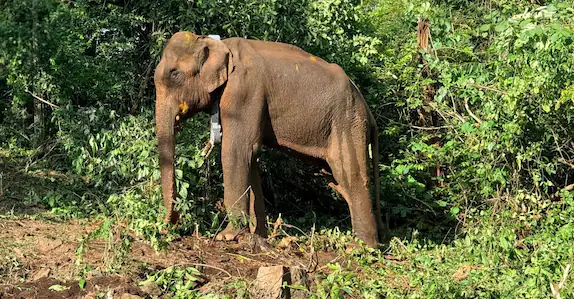
Although initially described as a tusker, field officials later clarified that the animal is a tuskless male elephant, popularly known as ‘Mozha’.
Forest officials said the elephant had been venturing into populated areas because it was unable to feed on its natural diet. Sources within the forest department team said the elephant was found to have a severe injury inside its mouth.
“Because of the injury, it wasn’t in a state where it could chew or crush hard, natural forest forage. That is exactly why it was refusing to go deep back into the wild. It kept wandering into the residential areas looking for softer alternatives, like easily accessible plantains and other agricultural plants. Once we subdued it, the medical team treated the injury by applying a healing mixture of turmeric powder and honey directly to the wound,” the RRT member said.
Gruelling chase through dense forest
The operation began around 7.30 am and involved nearly 50 personnel divided into separate teams for tracking, darting and logistics. The elephant was darted early in the morning, but the first tranquiliser failed to fully immobilise it.
“Because the elephant kept running, the initial dart didn’t take full effect. Tracking and chasing it through the thick jungle was incredibly difficult before we managed to land a second tranquilising shot,” said an official attached to Kodanad forest range office.
The wild elephant after being fitted with a radio collar. Photo: Special arrangement
The officer explained that veterinarians deliberately administer only the minimum required dosage during the first attempt to avoid the risk of an overdose, which may be harmful for the elephant.
“The elephant kept turning back, charging and bolting into the thicket. We had to track its path and follow it on foot through the dense jungle for roughly 20 km before it could finally be subdued with another dart at Vettampara in Pindimana panchayat,” the official said.
After the elephant was fully sedated, a JCB and specialised lifting equipment were brought into the forest. Its four legs were secured, and a crane sling was used to support and stabilise the animal to prevent injuries while it was handled.
The operation concluded around 4.45 pm after the elephant was fitted with a telemetry-enabled radio collar and released into the Vettampara forest.
Idukki MP Dean Kuriakose, Kothamangalam MLA Shibu Thekkumpuram, Kottapady panchayat president Umesh Sivakumar, Pindimana panchayat president KP George and other local representatives monitored the operation on-site.
Local representatives said the elephant’s unpredictable movements had severely disrupted daily life in both panchayats for over a month. “The elephant was a constant danger to both lives and property in both panchayats, particularly in areas bordering the jungle. Unlike larger herds that generally venture out under the cover of night, this lone animal was roaming around at all hours. It even intercepted a school bus on occasion. Residents have been terrified to leave their houses during daylight hours, and the elephant has caused widespread destruction to local crops,” Kottapady panchayat president Umesh Sivakumar told Onmanorama.
He said the threat was particularly serious in wards 1, 2, 3 and 4, with a lower primary school in Ward 3 being especially vulnerable.
Residents seek permanent solution
Despite the successful radio-collaring, residents remain sceptical and are demanding that the elephant be relocated to a distant forest, similar to previous translocation operations involving elephants such as Arikkomban.
“We are calling for the animal to be moved to a remote sanctuary far from human settlements, similar to how elephants like Arikkomban were handled. Just driving it back into the immediate woods won’t solve anything as it’s very likely to wander right back into our neighbourhoods in a matter of days,” Sivakumar said.
However, forest officials said the newly fitted radio collar would allow them to closely monitor the elephant’s movements and would help them keep it away from residential areas.
“From now on, we will be able to pinpoint exactly where the animal is positioned at any given moment. It allows us to monitor its actions around the clock and actively watch if it begins moving toward residential lines again,” an RRT member said.