

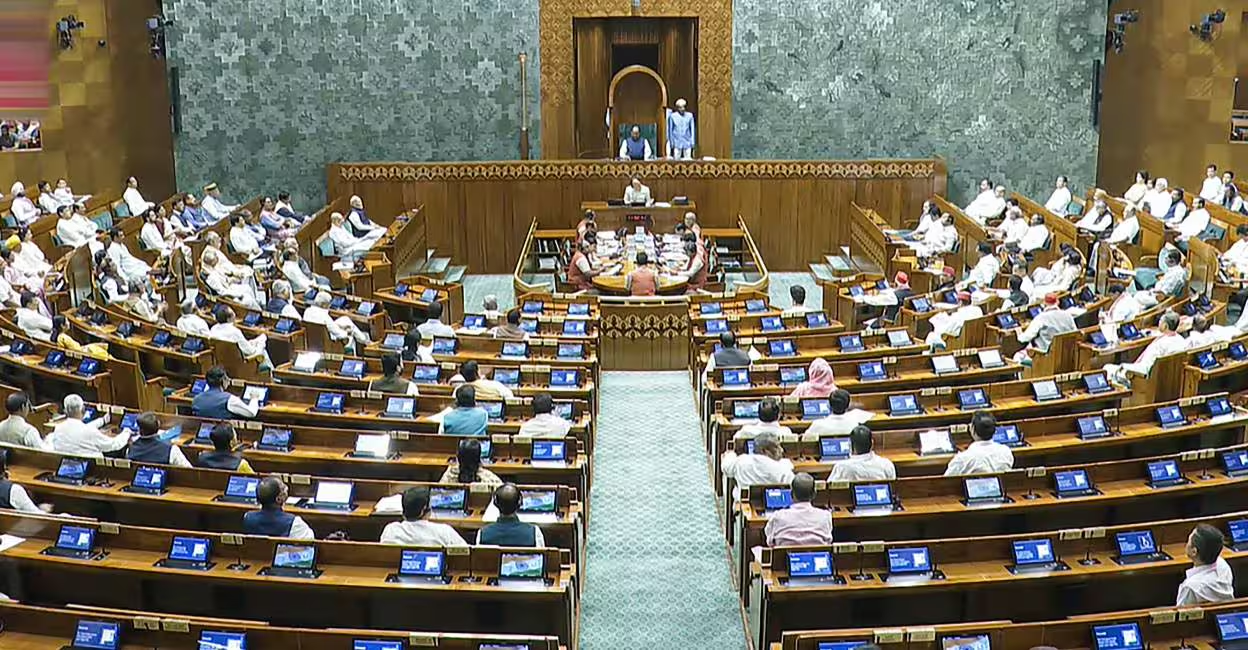
New Delhi: Days after nationwide student protests over the NEET paper leak controversy culminated in the resignation of Union Education Minister Dharmendra Pradhan, the Centre on Monday introduced a Bill in the Lok Sabha to strengthen the anti-paper leak law with stricter penalties and faster investigations.
The Public Examinations (Prevention of Unfair Means) Amendment Bill, 2026, introduced by Minister of State for PMO Jitendra Singh, proposes imprisonment of five to 10 years and a fine of up to ₹50 lakh for individuals found guilty of paper leaks or other unfair practices in public examinations.
For organised crimes related to examination fraud, the Bill proposes a minimum prison term of seven years and fines of up to ₹10 crore. The legislation also mandates that investigations into paper leak cases be completed within two months.
The Bill was introduced amid protests by Opposition members, who demanded a government response to the police action against students during the Cockroach Janata Party (CJP)-led march to Parliament on July 20.
Under the existing law, offenders face imprisonment ranging from three to five years, while those involved in organised cheating can be sentenced to five to 10 years in prison along with a minimum fine of ₹1 crore.
The amendment empowers all states and Union Territories to designate fast-track courts to hear paper leak cases. These courts will be required to conduct day-to-day hearings and complete trials within three months of the filing of the chargesheet.
The proposed law also enables the Centre to constitute a special task force to investigate paper leak cases wherever necessary.
After the Bill was introduced, Lok Sabha Speaker Om Birla invited senior Opposition leaders, including Saugata Roy (TMC), Manish Tewari (Congress) and N K Premachandran (RSP), to oppose its introduction, as required under parliamentary procedure. With no member speaking against its introduction, the Bill was formally tabled. Birla urged members to participate in the debate rather than continue sloganeering.
“It is the first step towards improving the public examination process. Instead of sloganeering, you should discuss the Bill in the House. The government will try to incorporate the improvements suggested by you,” he said.
Amid continuing protests, the Speaker adjourned the House till 2 pm.
The government announced the proposed amendments after student protests led by the CJP over alleged irregularities in the NEET examination gained nationwide momentum. Opposition protests over the issue had earlier disrupted Parliament, while Leader of the Opposition Rahul Gandhi said his party would decide its stand on the Bill after consultations.
The original Public Examinations (Prevention of Unfair Means) Act, 2024 was enacted following a series of paper leak controversies. It sought to curb unfair practices in examinations conducted by agencies including the Union Public Service Commission (UPSC), Staff Selection Commission (SSC), Railway Recruitment Boards, banking recruitment agencies and the National Testing Agency (NTA).
In the wake of the protests, Prime Minister Narendra Modi had promised stronger legal measures to tackle examination fraud and said such cases would be tried in fast-track courts.
The CJP ended its 36-day agitation on Saturday after the government accepted several of its demands, including the resignation of Dharmendra Pradhan. A day later, Modi announced the formation of a high-powered task force headed by Infosys co-founder Nandan Nilekani to recommend reforms aimed at making the country’s examination system leak-proof.
The amendment Bill notes that recent incidents of question paper leaks and examination malpractice have undermined the transparency and credibility of public examinations.
Besides prescribing tougher punishments, it empowers the Centre to frame detailed norms covering pre- and post-examination processes, including examination centre audits, biometric registration, candidate verification, question paper security, invigilation, evaluation protocols and provisions for scribes.
The Bill also lists 15 offences, including leaking question papers, tampering with OMR sheets, creating fake examination websites and issuing forged admit cards.