

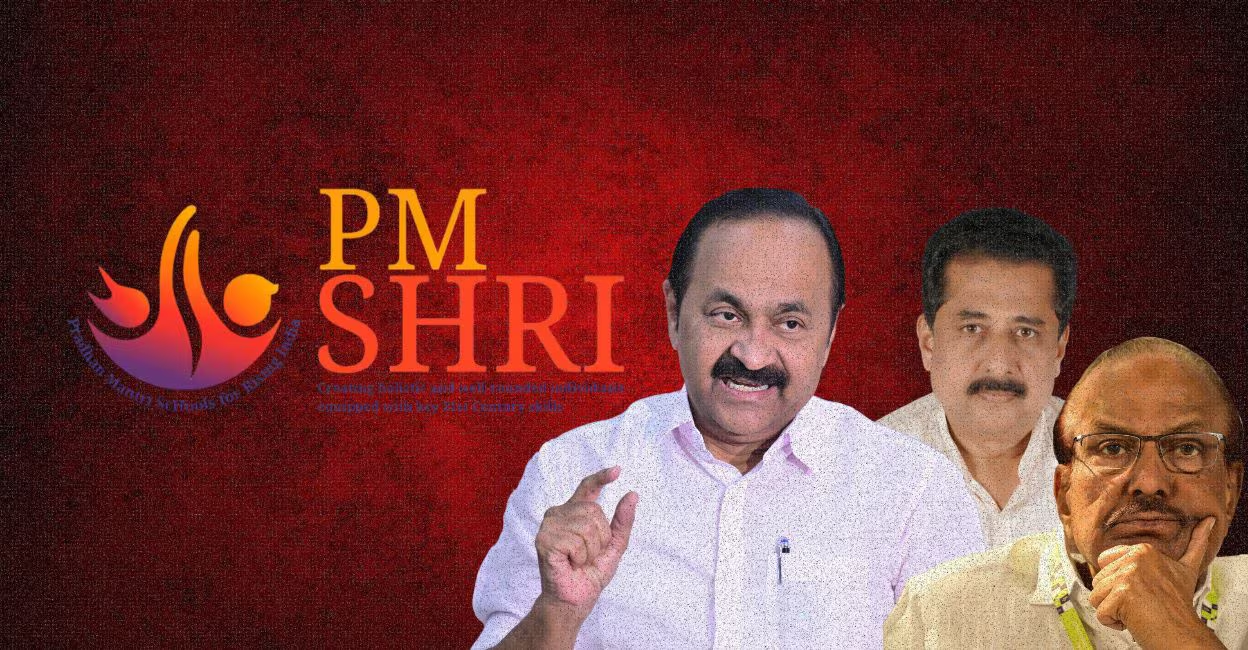
The UDF government had decided to go ahead with the PM-SHRI (Prime Minister’s Schools for Rising India) project the moment it assumed power in Kerala.
But before taking the plunge, the Congress and the Muslim League are in search of an impossible idea: A fine excuse to join PM-SHRI that would somehow help to preserve the credibility of their revolt against what they call the RSS-authored National Education Policy (NEP)-2020.
It is to find such a compelling justification that a four-member Cabinet Sub-Committee was constituted on July 17 under General Education Minister N Shamsudheen. To the chagrin of the Muslim League, UDF convenor Adoor Prakash jumped the gun.
Without waiting for the Cabinet Sub-Committee to give its opinion, Prakash blurted out, right after the UDF meeting on July 30, that the UDF government would go ahead with PM-SHRI. It gave the impression that there was a consensus in the UDF on embracing PM-SHRI.
This prompted industries minister P K Kunhalikutty to term as ‘101 per cent wrong’ reports that the UDF had discussed the issue. “The government will take a final decision on PM-SHRI only after the Sub-Committee’s report,” Kunhalikutty said on Friday.
Blame it on LDF
The primary excuse now, which is that the UDF government has no choice but to honour an agreement already signed by the previous LDF government, sounds too convenient. It is true that the LDF government discreetly signed the MoU with the Centre on October 23, 2025. But once the CPM realised it would be politically unsustainable, its government left the MoU to the termites.
Certain UDF leaders Onmanorama talked to said that the LDF at least conceded their folly and opted for the ‘politically honourable’ option of forsaking PM-SHRI.
“If the UDF government operationalises PM-SHRI, even the CPM, which had gone behind the back of the CPI and signed the MoU, will gain in moral strength,” a senior UDF leader said.
Rebellion and blackmail
Another pretext put out by the UDF, like the CPM earlier, is the need to obtain central funds under Samagra Shiksha Abhiyan. But the blocked SSA fund is a symbol of anti-Sangh Parivar resistance.
It was the previous LDF government’s objections to the NEP that caused the Centre to withhold SSA funds to Kerala.
In 2023-24, the year PM-SHRI began, the Centre paid only ₹141 crore when it should have transferred ₹328.83 crore. Meaning, the fund flow stopped the moment Kerala expressed its reluctance to join PM-SHRI as it based on NEP principles.
The Centre officially communicated that Samagra Shiksha was aligned with the NEP and PM-SHRI was a showcase of the NEP. In other words, opting out of PM-SHRI would deprive Kerala of SSA funds.
In 2024-25, the Centre was supposed to transfer ₹328.90 crore to Kerala under SSA. But not a single rupee was released. In 2025-26, after the LDF government signed the MoU in October 2025, ₹207 crore was released. The Centre’s obligation was ₹452.04 crore.
Until the last year of its governance, the LDF government had celebrated this ‘fund martyrdom’ as a memorial of its unyielding fight against right-wing politics. Eventually, money trumped principles.
NEP vs Congress
Like the CPM, the Congress, too, is fiercely opposed to the NEP.
At the national level, the Congress has said that the NEP will lead to commercialisation of education and communalisation of textbooks. The Congress is also convinced that the NEP will subvert the Right to Education Act passed by the UPA government in 2010.
The RTE Act had made it a constitutional obligation to have a primary school within one kilometre of every neighbourhood in the country, and an upper primary school within three kilometres of every neighbourhood. The NEP, on the other hand, speaks of ‘school complexes’, which the Congress fears would do away with the RTE Act’s neighbourhood schools.
Therefore, the first clause in the PM-SHRI MoU should have provoked the Congress to turn its back on the scheme. Here is what it states: “States will implement all the provisions of National Education Policy – 2020 in entirety within the entire state, as the main objective of this scheme is to showcase the implementation of NEP – 2020 through the PM SHRI schools.”
If rigorous adherence to its ideological position is what the Congress wants, dumping PM-SHRI is the easiest decision to make. Yet, like the LDF government before it, the UDF government is willing to accept PM-SHRI for the central funds.
Tamil Nadu was also deprived of nearly ₹ 2,500 crore SSA funds for refusing to join PM-SHRI. Rather than cave in to blackmail, Tamil Nadu has moved the Supreme Court. The UDF government, however, is in no mood for a legal fight either.
Fabricated challenges
The first step the UDF took to make the PM-SHRI decision look politically credible was to deliberately obscure the NEP factor. Not even the Muslim League speaks of the NEP.
Instead, they have shifted the goalposts. The UDF now attempts to whip up emotions over other challenges and claims that it would adopt PM-SHRI only if it could surmount these.
“We are trying to see whether the project can be implemented without adhering to the conditions put forward by the Centre. Under no circumstances will we allow the Centre to decide the school syllabus or select the schools for PM-SHRI,” Kunhalikutty said.
So here are two ideological challenges the UDF claims the PM-SHRI imposes on it. One, the drafting of school curriculum. Two, the selection of schools under PM-SHRI. Eager to project defiance, both the Congress and the League say that the Centre will be kept out of both these activities.
The Cabinet Sub-Committee has been asked to imbue these supposed challenges with ideological flourish. Fact is, one of these challenges is non-existent, and the other is easily surmountable.
Truth about challenges
Indeed, the framework of PM-SHRI Schools insists on the National Curriculum Framework or State Curriculum Framework “developed in accordance with the curricular and pedagogical structure of the National Education Policy”. In practice, this is not enforced.
West Bengal, for instance, joined PM-SHRI in 2023 and still employs its curriculum framework and not an NEP-based one. “The Centre had informed the previous government that they would not make a fuss about the curriculum,” a top General Education Department official said.
And as for the selection of PM-SHRI schools, the Centre has no role. Schools have been asked to self-apply on the Online Challenge portal. A maximum of two schools (one Elementary and one Secondary/Senior Secondary) will be selected per local body. The only prerequisite set is that schools that want to apply should satisfy certain conditions. These include a building in good condition, enrolment above the state average, at least one separate toilet each for boys and girls, potable drinking water facility, photo ID cards for teachers, separate hand wash, library and sports equipment.
Evidently, it is easy for the Centre to grant these two wishes. And once granted, the UDF government would want to claim it had secured central funds without compromising on principles.
In reality, Chief Minister V D Satheesan and Kunhalikutty will find it hard to deflect the charge that by adopting PM-SHRI their government had allowed the NEP to be Trojan-horsed into Kerala.