

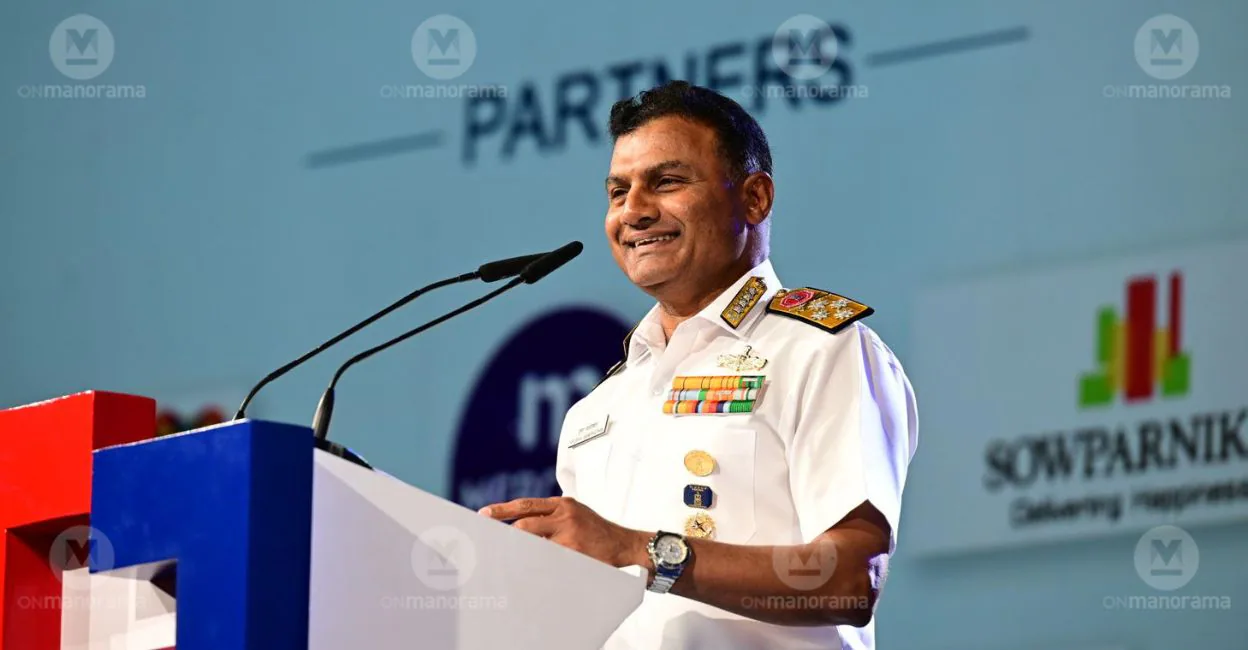
Warning that economic prosperity and maritime security are now inseparable, Chief of the Naval Staff Admiral Krishna Swaminathan said on Saturday that the Indian Ocean is no longer just a vital trade route and China’s rapid military and economic expansion reshaped the strategic Indian Ocean Region (IOR), turning it into a contested space and arena of geopolitical uncertainty and great-power rivalry.
Speaking on ‘Oceans of Influence’ at the Manorama News Conclave at Lulu Bolgatty International Convention Centre in Kochi, Admiral Swaminathan detailed how global power dynamics have pivoted toward Asia and the Indo-Pacific, placing the IOR directly at the heart of international strategic calculations.
“China has grown astoundingly fast – faster than all of us thought, certainly much faster than all of us liked. China is a threat to many countries; China is a challenge for us. And so, the Indian Ocean Region continues to be contested; it continues to be very, very competitive,” he said.
He said that the region has been at the centre of global security concerns since 2008, after the 9/11 attacks. The intensifying rivalry among major powers has now added another layer of unpredictability, requiring the Indian Navy to constantly expand its operational footprint, capabilities and technological sophistication.
Against the backdrop of China’s rise, the Admiral stressed that India, as an independent nation with an independent navy, monitors the security environment on a daily basis and prepares politically and operationally for any eventuality.
“The Indian Navy is a growing force, and it is ready to face any evolving challenges. We plan to grow in terms of our capability, numbers, and sophistication of the systems we have, so that while our threats and challenges continue to become more serious, our capabilities also grow commensurately, so that we can protect our national interests at all times,” he said.
Swaminathan added that the navy’s response is built around maintaining an uninterrupted watch over the Indian Ocean. The Indian Navy has kept two warships – one in the Gulf of Aden and another in the Gulf of Oman – continuously deployed on station since the 26/11 attacks.
At the Information Fusion Centre – Indian Ocean Region (IFC-IOR) in Gurugram, thousands of ships are tracked every day through pattern analysis, including their itineraries, cargo profiles and ports of call. This is complemented by round-the-clock aerial and naval surveillance of key maritime chokepoints, including the Strait of Hormuz.
The importance of that vigilance became particularly clear during the recent West Asia crisis. Swaminathan pointed out that disruptions at sea can quickly translate into economic consequences on land. Nearly 40% of India’s crude oil, more than 50% of its urea, and close to half of its LPG and LNG imports were vulnerable to disruptions.
The navy deployed a task force near the Strait of Hormuz and safely escorted more than 34 merchant vessels carrying critical cargo worth over ₹15,000 crore since the issue started in the Strait of Hormuz.
“India is the only country that has brought out the largest number of ships from the Strait of Hormuz,” he said.
Ocean beneath India’s economic rise
For India, maritime security is also inseparable from economic ambition. Swaminathan said the oceans would be a fundamental enabler of India’s journey from a $4-trillion economy to a developed nation by 2047.
Quoting 16th-century Ottoman Admiral Barbarossa, as cited by Indian strategic thinker Sardar K M Panikkar in his 1945 work ’India and the Indian Ocean’, he reiterated: “He who rules on the sea will shortly rule on land.”
Nearly 95% of India’s trade by volume and almost 70% by value moves by sea, he said. The seabed is equally important: submarine fibre-optic cables carry 99% of global data traffic, with India connected through 14 landing stations, including those at Kochi and Thiruvananthapuram.
But India also needs to capture more of the economic value generated by its maritime trade. The country pays foreign shipping liners around ₹6 lakh crore every year for freight services, an amount equivalent to building 30 INS Vikrant-class aircraft carriers annually.
The ₹69,000-crore National Shipbuilding Mission, along with modern transhipment facilities such as the deepwater port at Vizhinjam, could help change that equation.
Why Kerala matters
The Admiral said that Kerala occupies a particularly important place in this maritime landscape. Its strategic significance stretches from the 1741 Battle of Colachel, when Maharaja Marthanda Varma of Travancore defeated the Dutch East India Company, to the construction of India’s first indigenous aircraft carrier, INS Vikrant, at Cochin Shipyard.
“Kerala actually straddles important sea lanes that are crucially important for the global economy,” he said.
Maritime traffic rounding the Cape of Good Hope, moving through the Gulf of Aden and the Nine Degree Channel, passes off Kerala’s coast before heading towards the Malacca Strait. The same coastline, however, also presents security challenges, particularly from drug trafficking.
Swaminathan said the Navy is working with the Narcotics Control Bureau, Intelligence Bureau, state police and local fishing communities to counter the threat.
4 priorities and a message to Kerala’s youth
Swaminathan outlined four broad pillars guiding his tenure as Chief of the Naval Staff: maintaining supreme operational readiness in an active and volatile security environment; building long-term capabilities through technological modernisation and infrastructure enhancement; ensuring robust safety and information security across cyber, subsurface and aerial domains; and safeguarding the welfare and moral well-being of naval personnel.
He also had a message for Kerala’s young generation. Describing military service as a noble calling defined by a “contract of unlimited liability” to the country, he urged young people to consider a career in the Navy.
“Kerala has a natural connect with the sea. The Navy has a natural connect with the sea. So the youngsters here are natural naval sailors,” he concluded, calling on Kerala’s youth to help anchor India’s maritime future.