

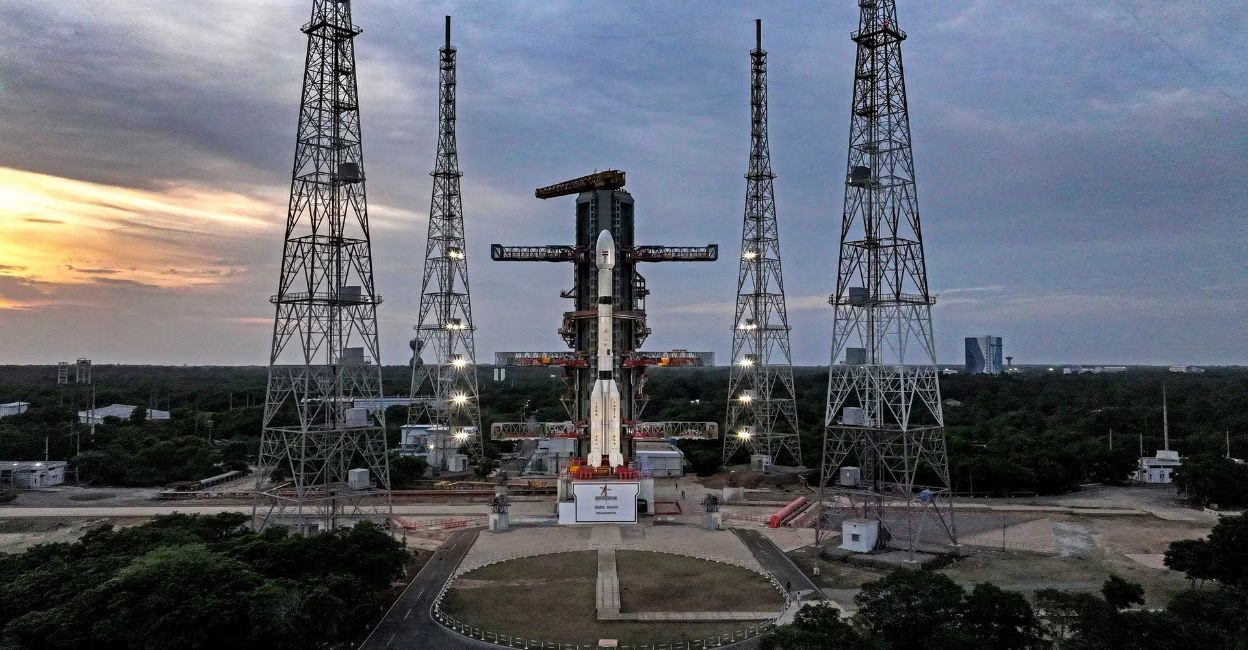
The Indian Space Research Organisation (ISRO) on Friday successfully launched EOS-05, the country’s first Earth observation satellite designed to operate in geosynchronous orbit, marking a significant milestone for the space agency.
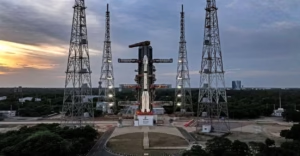
The 2,367-kg satellite was launched aboard the Geosynchronous Satellite Launch Vehicle (GSLV-F17) from the second launch pad at the Satish Dhawan Space Centre in Sriharikota at 2.55 am.
The launch came after a smooth 27-hour countdown that began at 11.30 pm on Wednesday. Despite the early hour and rain, a large number of people gathered at the spaceport to witness the launch.
EOS-05 is designed to provide near real-time Earth imagery and is expected to support applications in agriculture, disaster management and other areas requiring frequent observation of the Earth’s surface.
Unlike most Earth observation satellites that operate in low Earth orbit (LEO), EOS-05 is intended to be positioned at an altitude of around 36,000 km. In geosynchronous orbit, the satellite travels at the same rate as the Earth’s rotation, allowing it to maintain a consistent view of a particular region.
The GSLV-F17 is the 19th flight of India’s Geosynchronous Satellite Launch Vehicle. The 51.7-metre-tall, three-stage rocket has a lift-off mass of about 420.5 tonnes and uses a cryogenic upper stage.
Replacement for failed 2021 mission
The GSLV-F17/EOS-05 mission is a follow-up to the unsuccessful GSLV-F10/EOS-03 mission launched in 2021.
That mission was aborted 307 seconds after liftoff following an anomaly in the cryogenic upper stage. An analysis of post-flight data subsequently identified the anomaly as the cause of the mission failure.
Friday’s launch is particularly significant as it comes after a gap of nearly eight months since ISRO’s previous launch attempt.
On January 12 this year, the PSLV-C62 mission, which was carrying 16 satellites, failed to place its payloads into the intended orbit after an anomaly occurred in the rocket’s third stage.
The failure followed another unsuccessful PSLV mission in May 2025. The PSLV-C61/EOS-09 mission was terminated after a motor pressure issue resulted in a drop in chamber pressure.
With the successful launch of EOS-05, ISRO has now returned to flight operations after the recent setbacks.
Ahead of the mission, ISRO chairman V Narayanan had visited the Tirumala Tirupati Devasthanams and offered prayers at the Lord Venkateshwara Swamy Temple for the success of the launch.