


[ad_1]
A 2022 World Bank study on the impact of return migration from Saudi Arabia and the Gulf on the transfer of gender norms to Kerala has stirred a debate after Shashi Tharoor, Congress Member of Parliament from Thiruvananthapuram constituency, called it disturbing.
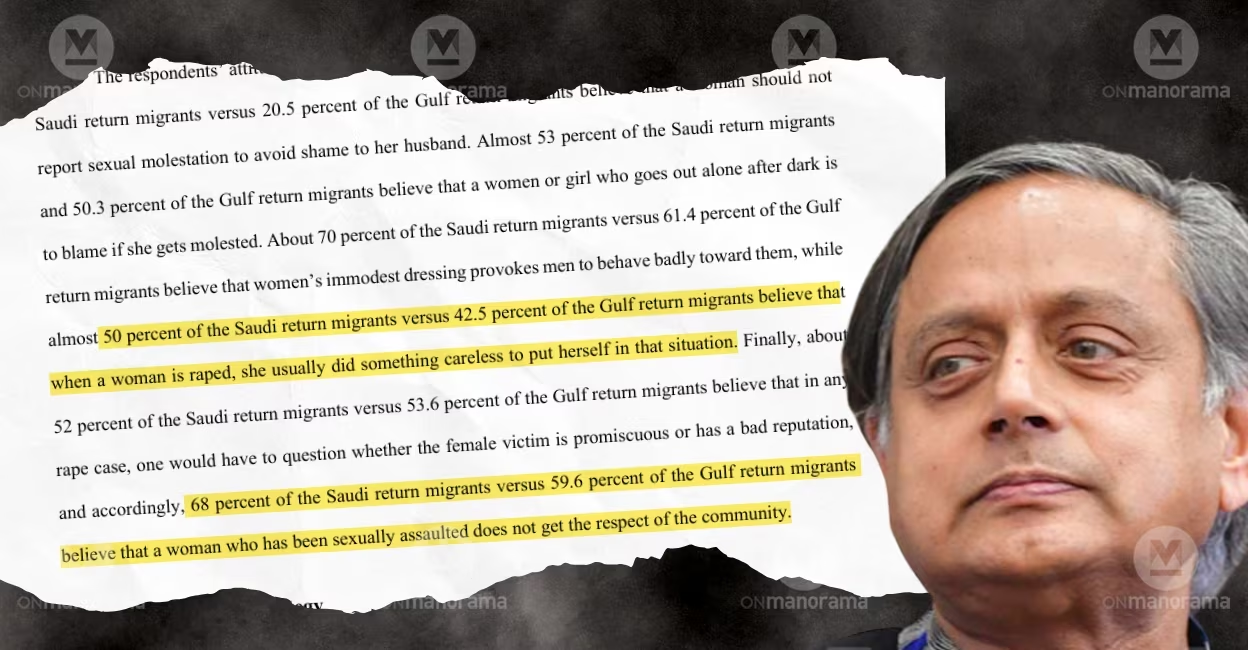
The paper, titled ‘Beyond Money: Does Migration Experience Transfer Gender Norms?’, finds that returning migrants from Saudi Arabia tend to exhibit conservative values on gender-based violence and extreme attitudes pertaining to the perpetration of physical violence against women.
Responding to the findings, Tharoor in a post on X, said the import of conservative and even reactionary attitudes and customs from abroad is fundamentally at variance with what Kerala has long been about.
The study, which began circulating on X days ago, was retweeted by Tharoor on Sunday. He also called for serious introspection and internal discussion within the Muslim community. “Kerala is proud of its record of educating Muslim girls and women to the same levels as boys and men,” he said, while condemning the ‘conservative’ and ‘reactionary’ attitudes and customs imported from abroad.
However, Irudaya Rajan, Chair of the International Institute for Migration and Development and one of the co-authors of the paper, argued that the discourse, although relevant, is misplaced in its emphasis on Gulf nations.
According to Irudaya Rajan, the fixation on the issue as one originating from the Gulf must be adjusted to account for the poor progression of women’s empowerment in Kerala. “Kerala takes pride in its literacy rates, which are balanced between both sexes. But it fares very poorly in terms of Female Labour Force Participation,” he said.
This reflects the social standing of women in the state and the inability of its culture to evolve beyond the literacy metric. He also stated that, beyond education, the scope of equality is constrained by conservative thinking that dictates women’s roles in families.
“Both positive and negative social influences are imported through migration. The reason why negative influences take root is that Kerala already has fertile soil for it,” he said.
He stated that the findings of the study are not exceptional, as the issues are already prevalent in the state. “Kerala women are empowered while their husbands are working abroad, but disempowered when they return. If there was absolute empowerment, it would not shift circumstantially,” he said.
Further, Irudaya Rajan also cited this as the reason why the youth in Kerala were seeking to settle outside the state, as its own environment is not conducive to progressive values. He added that while both positive and negative influences are brought back through migration, Kerala’s pre-existing social climate favours the conservative forces.
He emphasised that the discourse should shift towards the macro level, rather than emphasising specifics of the Gulf, as the marginal difference between the case in Kerala and the imported conservative ideas from the Gulf is negligible. “It’s like saying that we stole, but they stole a rupee more,” he said.
The report warns that even though social remittances can have beneficial impact on migrant populations and their home communities, the potential harmful ones should not be overlooked.
Some of the findings of the study
- Almost 85% of the returning migrants from Saudi Arabia believe that a man who cannot control his wife does not get the respect of the community, while 81% from the Gulf did the same.
- About 43% of Saudi Arabia return migrants believed a man has the right to beat his wife if she disobeys him. The corresponding figure among other Gulf return migrants was 37%.
- Nearly 32% of Saudi Arabia return migrants believed women should tolerate aggressive behaviour by their husbands to keep their families together. The figure was 35.2% among other Gulf return migrants.
- About 22% of Saudi Arabia return migrants believed women should not report sexual molestation to avoid bringing shame to their husbands. The figure among other Gulf return migrants was 20.5%.
- Nearly 50% of Saudi Arabia return migrants believed that when a woman is raped, she usually did something careless to put herself in that situation. The corresponding figure was 42.5% among other Gulf return migrants.
- 68% of Saudi Arabia return migrants believed a woman who has been sexually assaulted does not receive the respect of the community. The figure was 59.6% among other Gulf return migrants.
[ad_2]
Source link