

As Keralites fondly await the annual return of the legendary King Mahabali from the underworld, a literal pathway to the underworld made an unexpected and alarming appearance in Kasaragod. The bizarre geological discovery under a newly built house has sent shockwaves through the local community, serving as a stark warning to anyone planning to build a home in Kerala.
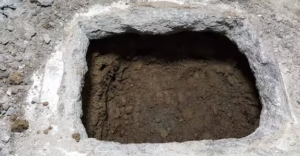
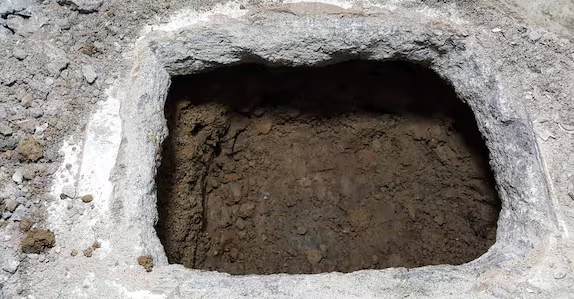
The incident occurred at Ottamavungal in Kuttikol panchayat, Kasaragod. After successfully completing the construction of their dream home, the owners set about digging a pit for the septic tank. To their utter horror, the excavation broke through into a massive, cavernous underground void. The cave, measuring over two metres in height, contains an active underground water stream, making physical exploration of its full scale extremely hazardous.
A false sense of security
Because Kasaragod is known for its sturdy laterite rock terrain, the homeowner had assumed the ground was rock-solid, requiring no special foundation precautions. This assumption has now turned into a nightmare. With a subterranean stream flowing right beneath the structure, the stability of the entire house remains highly precarious.
While such massive caverns are rare, soil instability is a frequent troublemaker in Kerala. Local news channels regularly report incidents of collapsing wells and sudden ground subsidence. Geologists and civil engineers agree that it is high time we scientifically analyse why these subterranean cavities and fractures are forming across the state.
The paradox of home construction in Kerala
This incident highlights a major, systemic oversight in Kerala’s housing sector: the outright neglect of professional geological and engineering advice. Today, building even a modest 1000 square foot home costs at least ₹20 lakh. Yet, remarkably, many people refuse to seek or pay for the services of qualified structural engineers and soil analysts during the planning phase.
Representative Image: Photo credit:menonsstocks/istock.com
It is a strange paradox. A Malayali won’t think twice before happily shelling out ₹2000 to ₹3000 on diagnostic tests for a medicine worth only ₹250 for a minor illness. However, when it comes to constructing a house—often the single largest financial investment of their lifetime—they routinely rely on guesswork rather than expert advice.
Why soil testing is non-negotiable
The terrifying discovery under the Kasaragod house teaches us a vital lesson: soil testing is an absolute necessity, regardless of where you build in Kerala. While some might view it as an unnecessary hurdle, a proper soil test is actually a vital investment, not an additional expense.
By drilling down to a specified depth, experts can analyse the different subterranean layers of sand, clay, hard rock, and soft stone. They assess the soil’s load-bearing capacity and water absorption qualities, providing a detailed report on the exact type of foundation required. In areas where solid rock is close to the surface, a standard rubble foundation suffices. However, if the ground consists of loose, moisture-heavy soil with poor bearing capacity, a more advanced engineering solution is mandatory. Once a foundation is laid and the house is built, it is virtually impossible to go back and fix it.
Spending around ₹25,000 on a comprehensive soil test before starting construction is a minor price to pay to ensure your home does not literally sink into the earth. It is time we stop taking our soil for granted.
The author is an overseer with the Local Self Government Engineering Department (LSGD) in Kerala. He can be reached at jubeeshmv@gmail.com.