

After helping around 1,000 households generate solar power, Perinjanam panchayat in Thrissur is taking the next step: planning the country’s first local body-led Battery Energy Storage System (BESS). A BESS uses lithium batteries to store excess solar power generated by households during the day and supply it to the grid during peak hours at night.
“With this project, Perinjanam will become the first local body to set up a BESS. Other battery storage projects are either being implemented or planned by KSEB or private companies,” said former panchayat president K K Sachith.
The project is a continuation of ‘Perinjanoorjam’, the panchayat’s solar initiative launched in 2017 to encourage households to generate their own electricity, reduce carbon emissions, address electricity shortages and bring down household expenses.
Sachith, under whose leadership the initiative was launched, told Onmanorama that 76 households joined Perinjanorjam in the past month alone. “We began this initiative in 2017 with the aim of encouraging households to generate their own power and address carbon emissions, electricity shortages and rising household expenses. Over the years, the project has expanded to around 1,000 households, and more continue to join. On September 23, 2018, the panchayat generated around 500 kW of electricity and the project was officially inaugurated by then Chief Minister Pinarayi Vijayan. Now, the panchayat is set to launch a BESS to store the excess electricity generated,” Sachith said.
Sachith is also the chairman of the consumers’ committee formed to oversee Perinjanoorjam while the panchayat acts as the facilitator. The committee has 15 executive members.
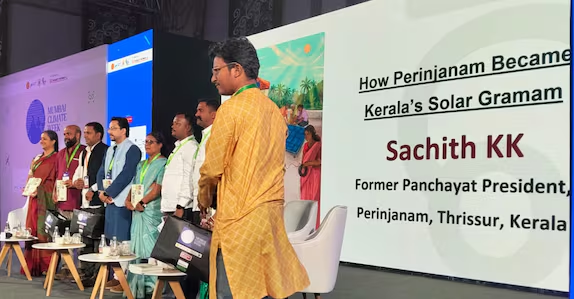
KK Sachith and others at the Bombay Climate Change seminar held by the Maharashtra Government. Photo: Special Arrangement
“Former KSEB chairman T N Manoharan, a native of Perinjanam, played a significant role in the project and provided technical guidance,” he said.
How ‘Perinjanoorjam’ began
The panchayat first focused on creating awareness among residents about rooftop solar. Officials from the Energy Management Centre and KSEB conducted an awareness meeting attended by around 500 residents. Nearly 300 households initially agreed to install rooftop solar panels, Sachith said.
For residents who could not afford the installation, the Perinjanam Cooperative Bank provided collateral-free loans. A total of ₹1.3 crore was sanctioned for this purpose. “Each resident only had to pay an amount equivalent to their electricity bill in instalments. This way, all the beneficiaries were able to repay their loans within four years. They are now earning an income from the surplus power generated,” he said.
The consumers’ committee also took responsibility for maintaining the solar installations. Maintenance was provided free of cost to consumers for the first six years.
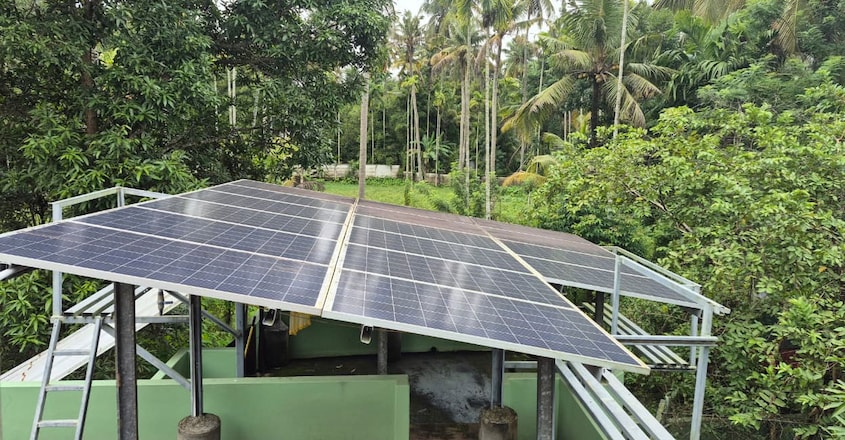
Solar panels installed on top of former panchayat president KK Sachith’s house. Photo: Special Arrangement
GPR Power Solutions, which won the tender to supply and install the panels in the panchayat, contributed an amount to the panchayat’s account towards maintenance, Sachith said. “There is an app through which consumers can lodge complaints and they are resolved within 24 hours,” he said.
The panchayat also ensured that it benefited from the project in its role as facilitator. A 9.5-kW solar plant was installed on the rooftop of Perinjanam Government School in the panchayat’s name.
The electricity generated by the plant is used to power around 800 streetlights. This has significantly reduced the panchayat’s electricity expenses, with the monthly bill for the streetlights falling to around one-third of what it was earlier, Sachith said.
“Maintenance at the panchayat level, including work related to bulbs, is carried out by women from Kudumbashree under a group called ‘Circuit Technology’. Those who are interested are trained in the work,” he added.
Sajeev Ramakrishnan, a resident of Perinjanam, said his family initially installed a 4-kW solar system at a cost of around ₹2 lakh eight years ago. They later upgraded it to 6 kW, spending another ₹1.5 lakh.
“Now, from a monthly bill of around ₹3,500, we pay only about ₹350. During gas shortages, we use an induction cooktop, which helps reduce household expenses. Now, my siblings, who live in five houses in the same compound, have also installed solar panels,” he said.
From generation to storage
In the next phase of the initiative, BESS will store excess solar power generated during the day and supply it to the grid during peak hours.
The Kerala government had earlier allocated ₹2 crore for the pilot project. Following the revision of the budget, the panchayat is checking whether the allocation has been retained.
“We have taken all the necessary steps to set up the storage system. The site has been identified, a detailed study has been conducted, and the project report has been submitted,” said panchayat president Raju T K.
Asar Social Impact Advisors prepared the BESS project report and submitted it to the state government.
“Panchayats do not have much say in the energy sector. BESS can help bridge this gap and make panchayats more self-sufficient in energy,” said Priya Pillai, Chief of Strategic Alliance at Asar.
KSEB officials told the project team that a major part of its losses comes from buying power from outside the state, Priya said. BESS could help address this by storing solar power generated during the day and supplying it to the grid during peak hours, she added.
According to Sachith, the system is expected to store around 3.16 MWh of solar energy generated each month and supply it to KSEB during peak hours.
“If KSEB pays energy producers half the amount it currently spends on purchasing power from outside the state, it could benefit both the producers and KSEB,” he said.
The Perinjanam model has already attracted attention from local bodies across India. The panchayat’s solar initiative has been used as an example for projects elsewhere, with panchayat representatives from Tamil Nadu among those who have visited Perinjanam to study the model, Sachith said.